WELLNESS & HEALTH · DR. HERMES
The Twelve Salts That Keep You Alive: The Biochemic Medicine of Dr. Wilhelm Schüssler
A meticulous, evidence-aware examination of the twelve tissue salts discovered in human ashes — their proposed cellular mechanism, the original texts, the American systematizers, and the clinical dead-ends they address.
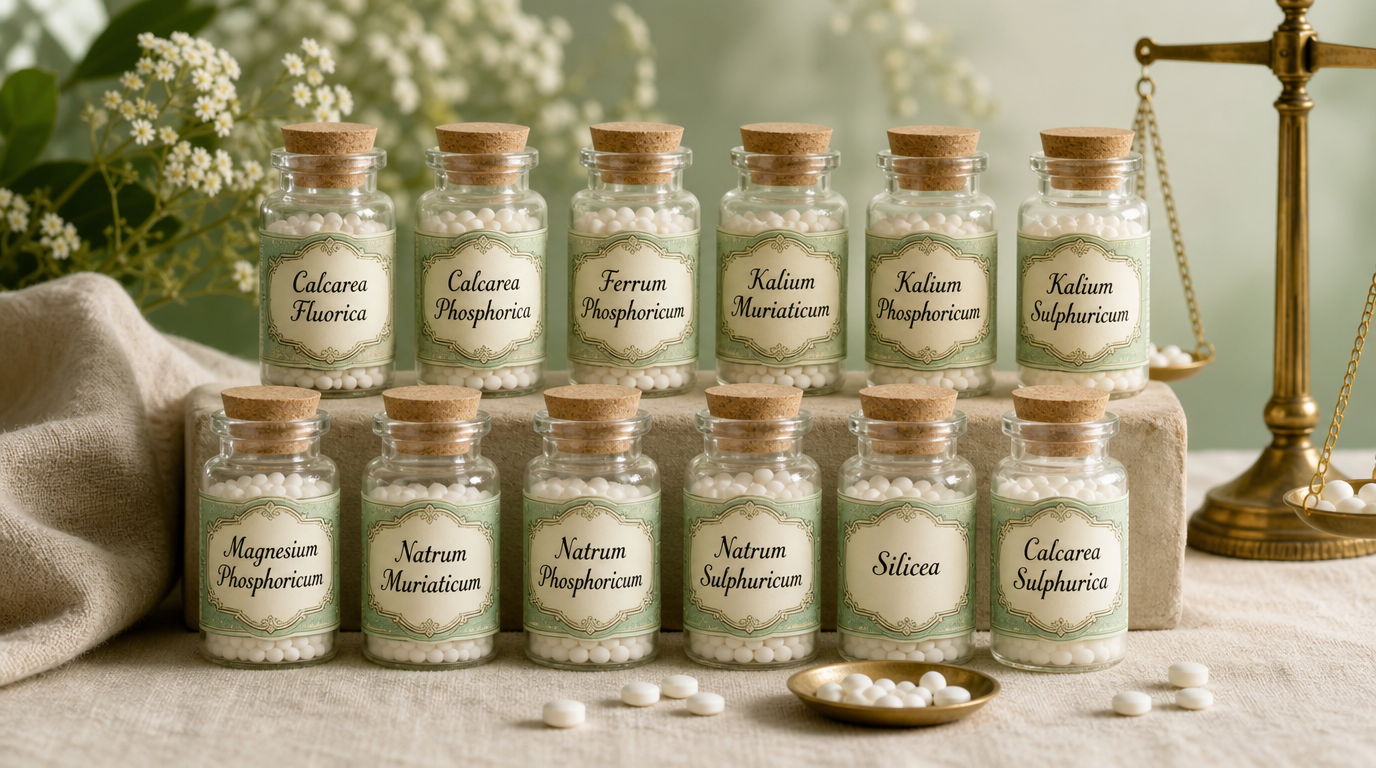
Every human body, reduced to its mineral skeleton, leaves behind precisely twelve inorganic salts. This is not poetry — it is cremation chemistry, and it was this very finding that led a German physician in the 1870s to build an entire system of medicine on twelve small tablets that most modern clinicians have never studied. This article is the first of a series dedicated to that system: the biochemic tissue salts of Dr. Wilhelm Heinrich Schüssler.
A Discovery Written in Ashes
Wilhelm Heinrich Schüssler (1821–1898) practiced in Oldenburg, Germany. Trained in the allopathic medicine of his time and later influenced by Hahnemann’s homeopathy, Schüssler asked a question that the pathology textbooks of his era had never posed: what, exactly, remains of the human organism when everything organic is consumed? The answer came from the analysis of cremated remains. When the organic matter — carbon, hydrogen, oxygen, nitrogen — is driven off by fire, what remains is a fixed mineral residue. And that residue, consistently and reproducibly, resolves into twelve inorganic salts.
Schüssler’s insight was radical in its simplicity: if these twelve salts constitute the inorganic ground-structure of the cell, then their deficiency in the cells — not in the blood serum, but at the level of the individual cell — is the biochemical substrate of functional illness. Disease, in his formulation, is not primarily an invasion; it is a local deficiency of a building material. Restore the deficient salt to the cell in a form the cell can use, and the cell resumes its physiological role. The body does not need to be “treated”; it needs to be supplied.
The Proposed Mechanism: Deficiency at the Cellular Level
This is the point where the biochemic system departs from conventional mineral supplementation, and the distinction matters. Standard mineral supplements aim to correct a measured deficiency in the blood — a deficiency that laboratory panels are designed to detect. Schüssler’s tissue salts address a different deficit: the functional availability of the salt to the cell, which may exist even when serum values are normal. The cell is not starving for the mineral in its diet; it is failing to utilize the mineral it already receives.
The proposed mechanism, as systematized by Schüssler and later by the American physician George W. Carey, is that of a bio-chemical catalyst. Each of the twelve salts governs a specific physiological function: mineral salts are the structural and electrochemical currency of the cell — they regulate osmotic exchange (Natrum Muriaticum), the transport of oxygen (Ferrum Phosphoricum), the conduction of nerve impulses (Kali Phosphoricum), and the elasticity of connective tissue (Calcarea Fluorica). When the cell is presented with the salt in a triturated, low-potency form (typically the 6X decimal potency), the molecule is available at the exact concentration the cell requires — not a pharmacological flood, but a physiological signal.
It is essential to be precise about the epistemic status of this mechanism. It is a coherent, internally consistent biochemical model developed in the late nineteenth century, refined by over a century of clinical practice in the German and Anglo-American biochemic tradition, and documented in the primary texts cited below. It is not — and this must be said with equal precision — a claim that modern randomized controlled trials have exhaustively validated. The reader interested in the tradition’s own clinical record should go to the sources themselves; they are meticulous, detailed, and unembarrassed.
The Twelve Remedies and Their Domains
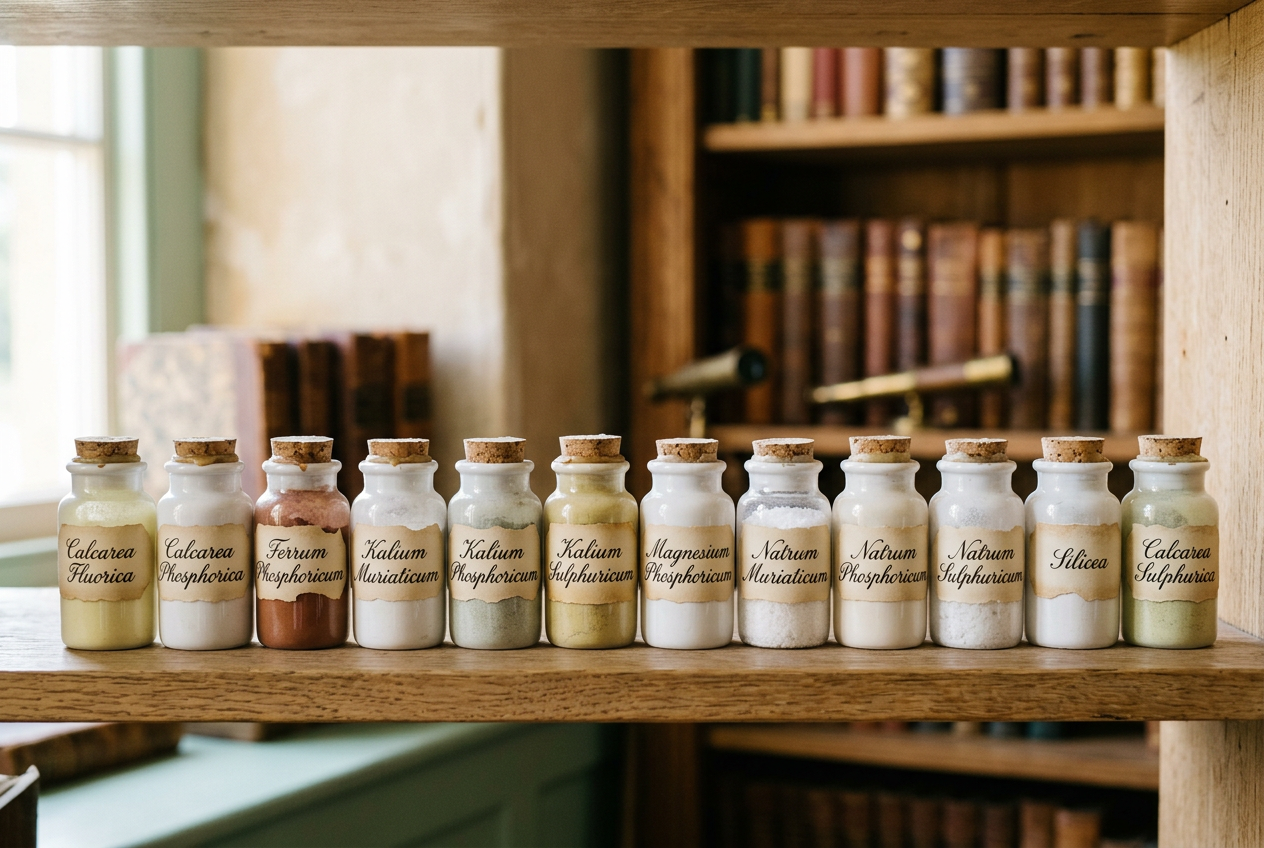
Each of the twelve salts is associated with a functional domain of the organism. The classical schema, from Schüssler’s own writings and the Carey repertory, runs as follows:
| # | Salt | Primary Function | Classical Indications |
|---|---|---|---|
| 1 | Calc Fluor | Elasticity of elastic fibers | Stretch marks, varicose veins, joint and connective tissue laxity |
| 2 | Calc Phos | Cell regeneration | Bone health, growth, convalescence, fatigue of the mind and body |
| 3 | Ferrum Phos | Oxygen transport, first-aid salt | Early inflammation, congestive states, the first 48 hours of a cold |
| 4 | Kali Mur | Fibrin regulation, detoxification | Congestion, white-coated tongue, glandular swelling, “white” discharges |
| 5 | Kali Phos | Nerve tissue nutrient | Stress, mental fatigue, anxiety, insomnia of the nervous type |
| 6 | Kali Sulph | Oxygen carrier of the skin | Chronic skin conditions, late-stage colds, “yellow” discharges |
| 7 | Mag Phos | Anti-spasmodic | Muscle cramps, tension headaches, sharp neuralgic pain, colic |
| 8 | Nat Mur | Fluid balance, water distribution | Dry skin, watery eyes, dehydration, grief states, sodium retention |
| 9 | Nat Phos | Acid neutralization | Acid reflux, indigestion, hyperacidity, gouty tendencies |
| 10 | Nat Sulph | Water elimination | Water retention, liver congestion, bloating, damp-exacerbated complaints |
| 11 | Silicea | Conditioner, eliminator | Hair, skin, nails, connective tissue strength, boils, suppuration |
| 12 | Calc Sulph | Purifier | Acne, slow-healing wounds, chronic suppuration |
What strikes any physician who studies the list without prejudice is the breadth of the system. This is not a single-remedy therapy. It is a complete physiological map — a materia medica of the inorganic ground layer of the human body. Every system, from the integument to the nervous system, has its salt.
And the map did not stop at twelve. In the decades after Schüssler’s death, his students and successors in the German biochemic school extended the system with a second series of mineral preparations — the complementary salts, numbered from 13 up to 27 — each drawn from further mineral and metallic compounds (among them potassium, lithium, manganese, copper, zinc, gold and selenium salts) and each mapped to additional functional domains beyond the original twelve. The extended series is not a later invention grafted onto the tradition; it is the natural completion of the same logic, produced by the same school, and it remains part of the standard biochemic pharmacopoeia — most continuously in Germany, where the tissue-salt tradition has never been interrupted. A practitioner who works with the full range has, in effect, a mineral map of the entire organism, from the elasticity of the vessel wall to the conductivity of the nerve.
The Books and the Practitioners: From Oldenburg to America
The primary text of the system is Schüssler’s own manual, An Abridged Therapy: Manual for the Biochemical Treatment of Disease, first published in 1873 and carried through twenty-five editions before his death in 1898 — the twenty-fifth edition being the last text he prepared himself. It remains the definitive statement of the theory, the pathological action, and the therapeutic application of the twelve remedies. Find the classic text on Amazon
The American systematization came from Dr. George W. Carey (1845–1924), whose The Biochemic System of Medicine (1896) and The Chemistry of Human Life extended Schüssler’s work into a complete pathology of the inorganic salts, and whose clinical repertory remains the working manual of biochemic practitioners to this day. The Biochemic System of Medicine by Dr. G. W. Carey Carey is often credited with the most rigorous statement of the modus operandi — the manner in which the inorganic cell-salts of the blood unite with organic matter to sustain the processes of life, and the manner in which their deficiency produces the symptom-complexes the repertory catalogues.
Where Conventional Medicine Stops: The Dead-End Cases
The biochemic system earns its keep precisely at the frontier where conventional medicine exhausts its tools. Consider the clinical landscape of the modern consulting room:
- The normal-labs fatigue. The patient who presents with profound, life-limiting fatigue — and whose every laboratory value, imaging study, and specialist referral returns “within normal limits.” Modern medicine has no diagnosis for the absence of a diagnosis. The biochemic tradition reads the symptom picture directly: nervous exhaustion with poor sleep quality points to Kali Phos; post-infectious depletion with bone-deep tiredness points to Calc Phos; congestive fatigue with poor oxygenation points to Ferrum Phos.
- The functional gastrointestinal disorder. Reflux, bloating, and dyspepsia with a completely negative endoscopy. The gastroenterologist concludes “functional” — a word that means we have observed the symptom and found no structural lesion. The biochemic system has a functional remedy for exactly this: Nat Phos for the hyperacid state, Nat Sulph for the bloated, damp liver state, Kali Mur for the congestive dyspepsia.
- Chronic muscle cramping and spasm. The patient with nocturnal leg cramps, tension headache, and colic who has been told to “drink more water and take magnesium.” When ordinary magnesium fails, the biochemic prescription is Mag Phos — the anti-spasmodic salt — often with immediate clinical response in the cramping, radiating, better-for-warmth picture that is its classical signature.
- The slow healer. Post-surgical or post-traumatic wounds, recurrent suppuration, chronic acne, brittle nails and hair. The surgical team has done its part; the tissue refuses to close. The biochemic layer addresses the building materials: Silicea for the connective-tissue weakling, Calc Sulph for the wound that will not clean itself, Calc Fluor for the skin that will not contract.
- Recurrent infections in the grey zone. The child — or the adult — with one cold after another, never quite septic, never quite well. Ferrum Phos at the first flush, Kali Mur for the catarrhal stage, Kali Sulph for the lingering tail: a staged protocol of extraordinary simplicity.
None of these cases require the biochemic physician to contradict the conventional diagnosis. The system does not dispute the endoscopy, the imaging, or the laboratory report. It simply observes that the conventional conclusion — “nothing is wrong” — is a statement about structure, not about function; and that a functional deficiency of a mineral salt is not visible on a scan. When surgery has been performed and the tissue will not heal, when the diagnosis is complete and the treatment is exhausted, the twelve salts remain available as the ground layer of repair. This is the dead-end the biochemic system was born to occupy.
What Is Actually in the Tablet
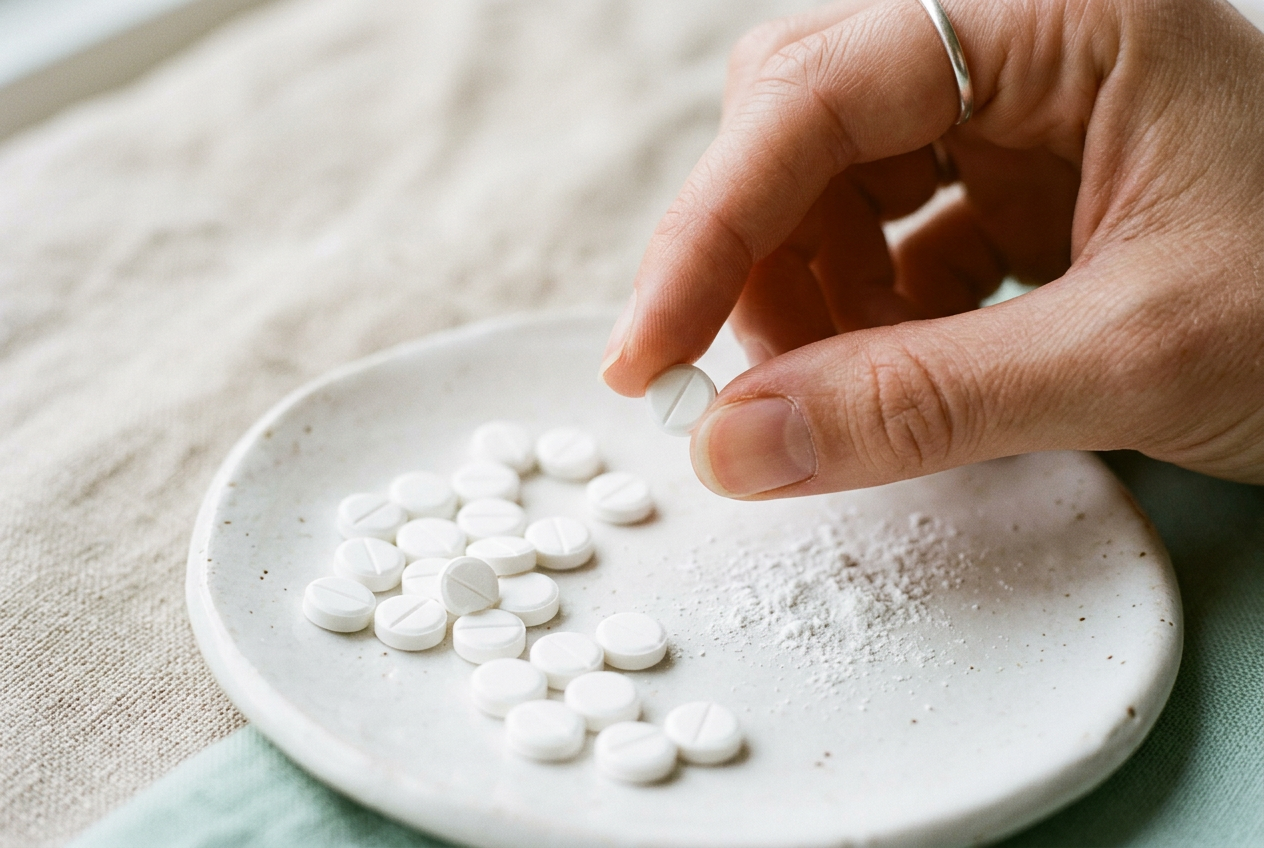
For a system this elegant, the tablet itself is almost disarmingly simple. Each tablet contains two things: the mineral salt, and a vehicle of lactose — milk sugar. The remedy is prepared by trituration, the classical pharmaceutical method in which the mineral salt is ground and mixed with lactose in a fixed geometric progression: one part of the previous trituration to nine parts of fresh lactose, ground and reground. The sixth step produces the 6X potency, in which one part of the original salt is carried in one million parts of lactose — the order of magnitude at which the mineral salts occur in the tissues, and the potency Schüssler settled on after years of clinical comparison. The tablet is then compressed from this triturated powder: a pure pharmaceutical-grade lactose base, quick-dissolving, with nothing else — no binders, no preservatives, no synthetic additives. In the classical preparations the lactose is free of casein and whey proteins, so even most lactose-sensitive individuals tolerate the tablets.
The composition matters because the vehicle is part of the remedy. The lactose is not an inert filler; it is the physiological sugar of milk, the medium in which the salt is carried at tissue concentration. The result is a small, white, faintly sweet tablet that dissolves in seconds under the tongue — a detail that matters more than it may seem, because it makes the remedy easy to take for everyone: children, the elderly, and patients who cannot swallow capsules.
For the reader accustomed to ponderal medicine — to milligrams and grams, to doses that can be weighed on a scale — the honest number must be stated plainly, because it is the point at which the biochemic method parts company with everything the pharmaceutical mindset expects. A 6X tablet contains the mineral salt in a proportion of one part in one million: by weight, the actual quantity of mineral in a single tablet is on the order of a millionth of a milligram — a quantity no scale can measure and no pharmacy can weigh. This is not a dilution error, a marketing trick, or a weakness of the preparation. It is the entire logic of the method. Schüssler’s premise is that the cell is not starving for the mineral in bulk — the mineral is present in the diet, in the blood, in the tissue — but that the cell has lost the ability to utilize it. What the triturated salt supplies is not a dose but a trigger: a catalytic signal at the exact concentration at which the mineral operates inside the cell. One does not flood a lock with water to open it; one turns a key. The infinitesimal quantity is the key. This is why the biochemic tradition insists on the 6X preparation rather than ponderal doses of the same mineral — a gram of calcium phosphate taken orally is a food supplement; a 6X tablet of Calc Phos is a physiological instruction.

How They Are Taken: The Practical Protocol
The method of administration is as important as the remedy itself. The classical instruction — from Schüssler’s manual, through Carey’s repertory, to modern biochemic practitioners — is to let the tablet dissolve slowly under the tongue, not to swallow it whole. Sublingual administration has a physiological reason: the mucosa under the tongue is rich in capillaries, and absorption from the oral mucosa delivers the triturated salt directly into the circulation, bypassing the digestive tract, where stomach acid and enzymes would otherwise act on the preparation. The remedy enters the system the way the cell needs to receive it: as a small, precise, absorbable dose.
The classical dose is one tablet three times daily. In acute states — the first flush of a cold, a muscle spasm, a sudden headache — the protocol is more intense: one tablet every fifteen to thirty minutes for the first hour or two, then spaced out as the symptom picture resolves. In chronic constitutional work, the dose is one tablet three times daily for a course of weeks or months, continued until the symptom picture it addresses has cleared. When the clinical picture is mixed — and it often is — two or three salts may be taken together in a single sitting; the classical combinations (Ferrum Phos with Kali Mur at the onset of a cold; Mag Phos with Calc Phos in cramping fatigue) are documented in the repertory. The tablets may be taken on an empty stomach or with food; for digestive complaints they are traditionally taken shortly before meals. For infants and young children, the tablet may be crushed and dissolved in a little water. The salts are compatible with conventional medication, and the guiding principle remains the minimum dose that suffices: the body is being supplied, not drugged.

The Evidence of Utility: What the Record Shows
The skeptical question is the right one: what evidence is there that these small, diluted tablets actually do anything? Examined without prejudice, the record rests on four legs.
First, the physiological grounding. The functions the tradition assigns to its twelve salts are not invented; they are the documented biochemistry of the minerals themselves. Iron is the oxygen carrier at the heart of hemoglobin — the domain of Ferrum Phos. Magnesium is the mineral of muscle relaxation and nerve conduction — the domain of Mag Phos. Calcium phosphate is the structural mineral of bone and of tissue regeneration — the domain of Calc Phos. Silicon is a trace element of connective tissue and epithelium — the domain of Silicea. The system invents no new physiology; it maps each remedy to a function physiology already recognizes, and claims something narrower and more interesting: that a functional shortfall of these minerals at the cellular level produces symptoms long before a deficiency is measurable in the blood, and that supplying the mineral in triturated form at tissue concentration addresses that shortfall.
Second, the historical and clinical record. The biochemic system has been in continuous clinical use for more than 150 years. Schüssler’s manual ran through twenty-five editions in his own lifetime — a pace of republication that no theoretical curiosity sustains, only a working tool in constant demand. The practice spread from Oldenburg across Germany, to Britain, and to the United States, where Dr. George W. Carey systematized it, and to India, where biochemic medicine remains a recognized component of the country’s pluralistic medical system to this day. This is not a footnote in the history of fringe medicine; it is one of the longest-running continuous clinical traditions in alternative medicine, with its own materia medica, its own repertory, and its own documented case literature.
Third, the regulatory and pharmacopoeial status. The twelve tissue salts are monographed in the homeopathic pharmacopoeias, and homeopathic medicines have been recognized as medicines under United States federal law since the Food, Drug, and Cosmetic Act of 1938 — recognition under which the major American manufacturers of cell salts still operate today, producing regulated products in inspected facilities. Whatever one thinks of the system, it is not an unregulated gray-market curiosity; it is a manufactured, regulated, continuously produced class of medicinal preparations.
Fourth, the clinical logic of the dead-end. The cases in which the system proves itself are precisely the cases where conventional medicine has exhausted its tools — the normal-labs fatigue, the functional gastrointestinal disorder, the chronic cramping, the slow healer. In those cases, the conventional conclusion that “nothing is wrong” is a statement about structure, and the biochemic prescription addresses function. The evidence for the system is therefore not a single dramatic trial but an accumulated clinical logic: a century and a half of use, a mechanism coherent with known mineral biochemistry, pharmacopoeial and regulatory standing, and a safety profile gentle enough for infants. For the reader who wishes to verify the clinical record directly, the primary texts — Schüssler’s manual and Carey’s repertory — are the place to begin; both are cited above.
Conclusion
Schüssler’s twelve tissue salts represent one of the most elegant, least understood, and most practically useful systems in the history of alternative medicine: a complete materia medica of the inorganic ground layer of the human organism, discoverable in the ashes of every human being who has ever lived, reducible to a small box of tablets that cost less than a single specialty co-pay. This series will examine each of the twelve salts in depth, the constitutional pictures, the combinatory protocols, and the clinical practice of the biochemic tradition.
Dr. Hermes Trismegistus
Doctorate in Schüssler Biochemic Medicine · Chief Medical Scholar, ABUGALY Holistic-Medical Institute
References
- Schüssler WH. An Abridged Therapy: Manual for the Biochemical Treatment of Disease. 25th ed. Philadelphia: Boericke & Tafel; 1898.
- Carey GW. The Biochemic System of Medicine: Comprising the Theory, Pathological Action, Therapeutical Application, Materia Medica and Repertory of Schüssler’s Twelve Tissue Remedies. St. Louis: F. August Luyties; 1896.
- Carey GW. The Chemistry of Human Life. 1919.
- Boericke W, Dewey WA. The Twelve Tissue Remedies of Schüssler. Philadelphia: Boericke & Tafel; 1910.
- Chapman JB, Perry EL. The Biochemic Handbook: What They Are, What They Will Do, How to Use Them. Exeter: New Era Laboratories; 1959.
- Clarke JH. A Dictionary of Practical Materia Medica. London: Homeopathic Publishing Company; 1900.
- Dewey WA. Practical Homeopathic Therapeutics. 2nd ed. Philadelphia: Boericke & Tafel; 1922.
- Gibson DM. Studies of Homeopathic Remedies. Beaconsfield: Beaconsfield Publishers; 1987.
- Homeopathic Pharmacopoeia of the United States (HPUS). Monographs of the twelve tissue salts.
- United States Congress. Federal Food, Drug, and Cosmetic Act. Pub. L. No. 75-717, 52 Stat. 1040; 1938.
- Boericke W. Pocket Manual of Homeopathic Materia Medica & Repertory. Philadelphia: Boericke & Tafel; 1927.
- National Library of Medicine. An Abridged Therapy: Manual for the Biochemical Treatment of Disease (1898) — digitized historical copy. Bethesda, MD: NLM.
Resources: Five Essential Books on the Tissue Salts
For the reader who wishes to go deeper, these five works form the core library of the biochemic tradition — the theory, the practice, and the clinical repertory:
- An Abridged Therapy — Dr. W. H. Schüssler. The founding text: the theory, the twelve remedies, and their therapeutic application, in the author’s own final edition. Buy on Amazon →
- The Biochemic System of Medicine — Dr. George W. Carey. The American systematization: biochemic pathology, materia medica, and the clinical repertory. Buy on Amazon →
- The Chemistry of Human Life — Dr. George W. Carey. The deeper statement of the biochemic theory: how the inorganic salts of the organism carry on the processes of life. Buy on Amazon →
- The Biochemic Handbook — J. B. Chapman & E. L. Perry. The practitioner’s practical companion: indications, dosages, and combinations of the twelve remedies. Buy on Amazon →
- The Twelve Tissue Remedies of Schüssler — W. Boericke & W. A. Dewey. The classical materia medica of the twelve tissue remedies. Buy on Amazon →
The Twelve Cell Salts: Individual Preparations
For those who prefer to work with each cell salt on its own, these are the twelve single-salt preparations in the 6X potency
Complete 12-Salt Kits
- Best Made Naturals — Classic Tissue Cell Salt Kit, Extra Large (12 salts, 6X) Buy →
- Best Made Naturals — Classic Tissue Cell Salt Kit (12 salts, 6X) Buy →
- Best Made Naturals — Economy Pack Tissue Cell Salt Kit (12 salts, 6X) Buy →
- Best Made Naturals — Tissue Cell Salt Kit, Lactose-free (12 salts, 6X) Buy →
The Twelve Cell Salts Combined in One Tablet
Hyland’s Bioplasma — the twelve cell salts combined in a single quick-dissolving tablet Buy on Amazon →