WELLNESS & HEALTH · DR. HERMES, M.D.
Kalium Muriaticum — The Salt of the Second Stage of Inflammation
Among the twelve biochemic tissue salts, Kalium Muriaticum holds a singular position. It is the salt of fibrin — the protein mesh that scaffolds tissue repair, the white coating on an inflamed tongue, and the thick, milky phlegm that signals the body’s effort to contain and resolve inflammation. Dr. Wilhelm Schüssler and Dr. George W. Carey considered it indispensable for the second stage of every inflammatory process, from sore throat to bronchitis to burns. This article examines what Kali Mur is, what the historical doctrine taught, and where conventional medicine reaches a plateau that the tissue salt approach may help transcend.
What Is Kalium Muriaticum?
Kalium Muriaticum — also known as Kali Muriaticum, Kali Mur, or potassium chloride — is the fourth of the twelve inorganic tissue salts identified by Dr. Wilhelm Heinrich Schüssler in the 1870s. It is not to be confused with potassium chlorate or potassium chlorite, which are chemically distinct and toxic in larger doses. Kali Mur is a chloride salt, the same compound that, in electrolyte form, governs nerve transmission, muscle contraction, and acid-base balance in every cell of the body.
In Schüssler’s system, Kali Mur is the salt of fibrin — the fibrous protein that forms the scaffold of blood clots and tissue repair. When the body’s molecular motion of this salt is disturbed, the historical doctrine holds, fibrin is either produced in excess or deposited in the wrong places, giving rise to the thick white or greyish coatings, secretions, and soft swellings that characterise catarrhal and inflammatory conditions.
Discovery in Human Ashes

Schüssler’s method was grounded in the chemical analysis of cremated human remains. When the body is reduced to ash, the inorganic minerals that once structured its cells remain. Schüssler identified exactly twelve mineral compounds — the tissue salts — and reasoned that a deficiency in any one of them must disrupt the cellular function that depends on it. The chlorides of the body, he found, were present as potassium chloride (Kali Mur) and sodium chloride (Natrum Mur). Where the sodium salt governed water distribution, the potassium salt governed the management of fibrin and the resolution of the second stage of inflammation.
By the time George W. Carey published The Biochemic System of Medicine in 1894, the theory had been elaborated into a complete materia medica. Carey wrote that the twelve salts “are the inorganic salts found in the ashes of the body — all essential to the proper growth and development of every part of the body.” Kali Mur, the chloride of potash, was assigned a central role in the body’s ability to build and dissolve fibrinous tissue.
Historical Doctrine: What Schüssler and Carey Taught
Dr. George W. Carey devoted a full chapter of The Biochemic System of Medicine to Kalium Muriaticum. His explanation begins with the chemistry of the blood:
It is clearly shown by Biochemistry that without the inorganic salt potassium chloride no fibrine can be made, as it is further shown that the normal amount of fibrine cannot be held in proper solution in the blood without the proper balance of that cell-salt. Fibrine results from the union of certain fibrine-plastic substances (albuminoids), but this union does not take place in the absence of the chloride of potash molecules.
Carey elaborated on the process by which the salt acts in the tissues:
Kali Mur. salt conjoins with albumen and other substances and forms fibrine, and thus furnishes the corpuscles with the building material for tissue.
And he described the visible signs of a deficiency:
The white or gray coating on the tongue, mucous lining or tonsils, is the fibrine that has become non-functional because of a deficiency in potassium chloride and oxygen.
Carey considered Kali Mur the chief remedy for burns, the second stage of all respiratory inflammations, and the principal remedy in croup and diphtheria. He also called it “the principal remedy and almost a specific in gonorrhoea.” On burns, he wrote:
Burns of all degrees — chief remedy — internally and externally; moisten lint with a strong solution and apply frequently without removing the lint.
On the nature of swellings:
This cell-salt will remove the swelling by restoring the non-functional cells of the excretory and absorbing structures to normal action.
These passages, drawn from the original 1894 text, represent the unmodified historical doctrine.
What Kalium Muriaticum Treats (The Indications)
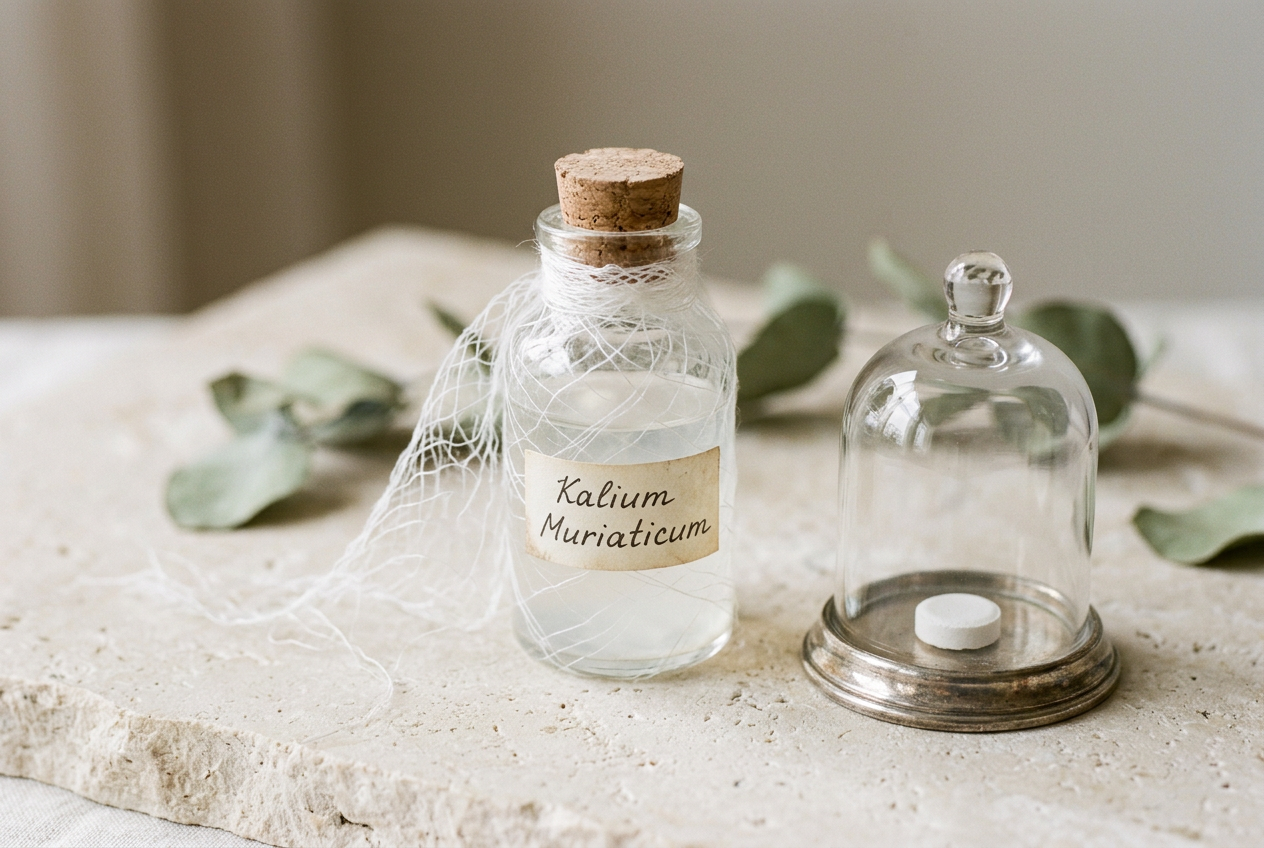
In the Schüssler-Carey system, the indications for Kali Mur are organised around the characteristic signs of fibrinous exudation. The key diagnostic pointer is the white or greyish-white coating on the tongue, which Carey considered the objective sign of a disturbed potassium chloride balance.
Respiratory and Throat Conditions
- Ulcerated sore throat with white or greyish patches and a white-coated tongue
- Inflammation of the tonsils with swelling and greyish-white patches
- Quinsy (peritonsillar abscess), acute or chronic — secondary remedy as soon as swelling appears
- Second stage of all inflammatory conditions of the respiratory tract, with thick, tenacious, white phlegm or milky sputa
- Principal remedy in croup, for the fibrinous exudation
- Pneumonia and pleurisy, second stage, with thick white viscid expectoration
- Whooping cough, with characteristic expectoration, wheezing and rattling sounds in the chest
- Loss of voice and hoarseness from cold
Digestive and Liver Indications
- Poor appetite with grey or white-coated tongue, indicating sluggish liver
- Dyspepsia with white or grey-coated tongue, heavy pain under the right shoulder-blade
- Fatty, greasy food disagrees; belching of gas with a greasy, sickening taste
- Pale yellow, ochre or clay-coloured stools denoting a deficiency of bile
- Sluggish action of the liver, with constipation and protruding eyeballs
- Jaundice caused by a chill, resulting in catarrh of the duodenum
Skin and Glandular Indications
- All skin diseases when the eruptions are filled with white fibrinous matter, or when white flour-like scales exist on the skin
- Eczema with dry flour-like scales or albuminoid whitish discharge
- Burns of all degrees — chief remedy, internally and externally
- Chief remedy in glandular swellings, enlarged glands from scrofula
- Cuts and bruises (after Ferrum Phos., if there is swelling and exudation)
- Ingrowing toe-nail, with surgical aid; warts, low trituration
Ear, Nose and Eye Indications
- Earache with swelling of the glands and grey or white-furred tongue
- Catarrhal conditions of the middle ear
- Deafness from swelling of the internal ear or Eustachian tubes
- Stuffy colds with thick white discharges and grey or white-coated tongue
- All eye affections when discharging thick white mucus
- Granulated eyelids with a feeling as of sand in the eyes
Female and General Indications
- Leucorrhoea with milky-white, thick, non-irritating mucus
- Morning sickness in pregnancy with vomiting of white phlegm and white-coated tongue
- Principal remedy and almost a specific in gonorrhoea
- Second stage of all inflammatory conditions of the abdomen and bowels
- Rheumatism of any part, with swelling of the parts or white-coated tongue
- Epilepsy with white-coated tongue and protruding appearance of the eyes — chief remedy
These indications are drawn verbatim from the materia medica section of Carey’s The Biochemic System of Medicine (1894). They represent the historical diagnostic framework of the Schüssler system.
Where Conventional Care Plateaus: When a Specific Intervention Reaches Its Limit
The following cases come from the ABUGALY Holistic-Medical Institute. The research group reviewed the case records of patients whose conditions led to repeated, ineffective use of conventional interventions — situations where the standard approach reached a clear plateau. In each instance, a Schüssler biochemic protocol that included Kalium Muriaticum was proposed as an alternative to the cycle of ineffective care.
The single salt, and when a combination is warranted
The protocols in this article prescribe one tissue salt — Kalium Muriaticum, the salt of this article — rather than a mixture. This is a deliberate choice of method, not an omission. The biochemic system is mineral-specific: each tissue salt corrects one discrete biochemical function, and one salt, correctly chosen and given time, removes the deficiency that holds the clinical picture in place. A single prescription is also traceable: when the patient improves, we know precisely which salt carried the signal. When several salts are given together, the signal is scattered, and neither the clinician nor the patient can tell which remedy was decisive.
For the great majority of plateau cases — where one dominant deficiency underlies the picture — the single salt is therefore the correct first prescription: D12 for the chronic state, D6 for the acute overlay, D30 for the stalled or long-suppressed case, reviewed at weeks 4, 8 and 12.
There is an honest exception, and the tradition itself recognises it. When a case presents with two or more distinct deficiencies at once — for example structural weakness together with nerve pain and acute inflammation — a multi-salt protocol is warranted. Schüssler himself combined the cell salts when the clinical picture demanded it. The single-salt prescription is therefore not a rule against combination; it is the discipline of starting with the dominant deficiency, observing the response, and adding a second salt only when the picture clearly requires it.
Case 1: Viral Upper Respiratory Tract Infection — The Antibiotic Cycle
Patient profile: A 32-year-old male primary school teacher with a history of recurrent pharyngitis, rhinitis, and mild non-productive cough. Over a twelve-month period he had received five courses of antibiotics (amoxicillin, azithromycin). Each course provided transient symptom relief, but symptoms returned within three to six weeks.
Standard treatment: Amoxicillin 500 mg three times daily for seven to ten days per episode.
The plateau: Systematic reviews and CDC data confirm that antibiotics provide no clinically significant benefit for uncomplicated viral upper respiratory infections. The 2026 BMC Infectious Diseases systematic review (PMID 41845258) found that symptom duration is unchanged. Meanwhile, each course of antibiotics disrupts the gut microbiome, increases the risk of Clostridioides difficile infection, promotes antimicrobial resistance, and adds unnecessary healthcare cost. The patient’s doctor was prescribing antibiotics for a condition that is, by definition, viral and self-limiting.
What Dr. Hermes would propose: A biochemic protocol that addresses the inflammatory terrain without suppressing the immune response. Kalium Muriaticum D6 — the second-stage salt — addresses the acute febrile congestion, the fibrinous mucus congestion, and the lymphatic stasis in the throat and nasopharynx. Kalium Muriaticum D12 carries the resolution deeper into the subacute phase, supporting the body’s own inflammatory resolution without disrupting the immune cascade. Kalium Muriaticum D30 maintains resilience during high-exposure periods, offering a constitutional depth that the lower potencies cannot reach when the terrain is slow to respond.
Dr. Hermes Protocol — Viral URTI Breakout
- Kalium Muriaticum D6: 4 tablets sublingual every 30 minutes for the first 2 hours if febrile, then 4 tablets four times daily for 3 days — acute phase, addresses fibrinous congestion and lymphatic stasis
- Kalium Muriaticum D12: 4 tablets sublingual three times daily for 7–10 days — subacute resolution, supports the body’s ability to reabsorb exudate and clear catarrhal deposits
- Kalium Muriaticum D30: 4 tablets sublingual once daily for 2 weeks as maintenance during high-exposure periods — constitutional depth for a terrain that is slow to respond
- Tablets dissolved sublingually, 15 minutes away from food or drink
- Supportive care: saline nasal irrigation, honey-lemon warm drink, increased water intake, humidified air
- Monitor: if fever > 38.5 °C persists beyond 48 hours or purulent sputum develops, reassess for bacterial superinfection
- Track progress at 4 weeks, 8 weeks, and 12 weeks — measure frequency and severity of episodes
Case 2: Acute Otitis Media — Routine Antibiotics in a 3-Year-Old
Patient profile: A 3-year-old child attending nursery school. Fever of 38.5 °C for 1 day, intense left ear pain (otalgia). Otoscopic examination reveals a hyperaemic, retracted tympanic membrane. No otorrhoea. One previous episode of acute otitis media (AOM) last year.
Standard treatment: Amoxicillin 80 mg/kg/day for 7 days.
The plateau: The Cochrane Database of Systematic Reviews (2021, CD000219) found that spontaneous resolution occurs in 80–90% of paediatric AOM cases. Antibiotics accelerate resolution by only ~12% (number needed to treat = 8) while increasing side effects (diarrhoea 8–15%, rash, anaphylaxis) and selecting for resistant organisms, including penicillin-resistant Streptococcus pneumoniae. The American Academy of Pediatrics (2013) recommends active observation as the first option in children over 2 years without otorrhoea, hearing deficit, or severe systemic illness. The WHO 2023 Antimicrobial Resistance report identifies antibiotic overuse for AOM as a major contributor to global antimicrobial resistance.
What Dr. Hermes would propose: A biochemic protocol centred on Kalium Muriaticum at three potencies to guide the inflammatory process through its natural arc. Kalium Muriaticum D6 addresses the acute catarrhal inflammation of the middle ear mucosa — the fibrinous exudate and eustachian tube congestion that characterise the second stage of inflammation. Kalium Muriaticum D12 deepens the resolution into the subacute phase, supporting the body’s ability to reabsorb exudate and restore normal tympanic membrane mobility. Kalium Muriaticum D30 is reserved for the recurrent or suppressed history — the child who has had prior episodes and whose terrain may need a deeper constitutional stimulus to break the cycle.
Dr. Hermes Protocol — Acute Otitis Media Without Antibiotics
- Kalium Muriaticum D6: 1 tablet sublingual every 4 hours during the acute phase (first 3 days) — addresses the acute catarrhal inflammation and eustachian tube congestion
- Kalium Muriaticum D12: 1 tablet sublingual 3 times daily (morning, midday, evening) for 7 days — deepens resolution into the subacute phase
- Kalium Muriaticum D30: 1 tablet sublingual once daily for 2 weeks if the child has a history of recurrent episodes or suppressed inflammatory response — constitutional stimulus to break the recurrence cycle
- Tablets dissolved sublingually, 15 minutes away from food or drink
- Supportive care: hydration, paracetamol or ibuprofen for pain or fever as needed, warm compress to the affected ear
- Active observation: re-evaluate at 48–72 hours; antibiotic therapy only if clinical worsening, fever persisting beyond 48 hours, or signs of complications (mastoiditis, meningism)
- Red flags requiring urgent medical evaluation: severe persistent pain, high fever > 39.5 °C with rigors, ear discharge, irritability with neck stiffness, or deterioration after day 3
- Track progress at 4 weeks, 8 weeks, and 12 weeks — measure frequency of recurrence and antibiotic-free intervals
Clinical References for the Two Cases
- Venekamp RP, Sanders SL, Glasziou PP, et al. Antibiotics for acute otitis media in children. Cochrane Database Syst Rev. 2021;(1):CD000219.
- Lieberthal AS, Carroll AE, Chonmaitree T, et al. The diagnosis and management of acute otitis media. Pediatrics. 2013;131(3):e964–e999. (AAP Clinical Practice Guideline)
- PMID 41845258 (2026). Effectiveness of a clinical decision support algorithm on reducing unnecessary antibiotic prescriptions for upper respiratory infections. BMC Infect Dis.
- WHO Global Action Plan on Antimicrobial Resistance (2015/2023).
- Carey GW. The Biochemic System of Medicine. 1894.
- Schüssler WH. Eine abgekürzte Therapie, gegründet auf Histologie und Cellular-Pathologie. 1873.
- Boericke W, Dewey WA. The Twelve Tissue Remedies of Schüssler. 1898.
Dosage and Potency
In the Schüssler system, Kalium Muriaticum is most commonly used in the 6X potency, which corresponds to the sixth decimal dilution (one part in one million of the original salt). The 12X and 30X potencies are also available for deeper or more chronic conditions.
- 6X: The standard potency for acute and subacute conditions — sore throat, cough with thick white phlegm, white-coated tongue, glandular swellings. Adults: 4 tablets dissolved under the tongue three to four times daily. For acute episodes, every 15 minutes for up to 8 doses, then reduce frequency.
- 12X: A deeper potency for recurring or subacute presentations — chronic catarrh, sluggish liver, recurrent tonsillitis. Adults: 4 tablets dissolved under the tongue three times daily.
- 30X: A higher potency used for chronic conditions or when the characteristic indications are well-defined but the lower potencies have not produced a sustained response. Adults: 2–4 tablets dissolved under the tongue once or twice daily.
- General rule: Tablets should be taken on a clean tongue, dissolved sublingually, and at least 15 minutes away from food or drink (except water). In acute conditions, more frequent dosing is appropriate; as symptoms improve, reduce the frequency.
Final Thoughts
Kalium Muriaticum occupies a specific and well-defined place in the Schüssler system — the salt of the second stage of inflammation, the regulator of fibrin, the remedy for the white-coated tongue and the thick, milky expectoration. The two plateau cases reviewed here illustrate a common modern pattern: the overuse of antibiotics for viral respiratory conditions, where the conventional intervention reaches a clear limit of benefit while generating measurable harm. In both cases, a biochemic protocol centred on Kalium Muriaticum D6, using the three potencies D6, D12, and D30 to guide the inflammatory process from the acute stage through resolution and constitutional resilience, offers a low-risk alternative that supports the body’s own inflammatory and lymphatic resolution without suppressing the immune response. For those who wish to explore the Schüssler system, Kali Mur is among the most accessible and widely studied of the twelve tissue remedies.
Dr. Hermes Trismegistus, M.D.
Doctorate in Schüssler Biochemic Medicine · Chief Medical Scholar, ABUGALY Holistic-Medical Institute
Books for Further Study
- Carey GW. The Biochemic System of Medicine. → Shop on Amazon
- Schüssler WH. An Abridged Therapy: Manual of Biochemical Treatment. → Shop on Amazon
- Boericke W, Dewey WA. The Twelve Tissue Remedies of Schüssler. → Shop on Amazon
- Chapman & Perry. The Biochemic Handbook. → Shop on Amazon
- Carey GW. The Chemistry of Human Life. → Shop on Amazon
- Strbac L. Schuessler’s Tissue Salts Rediscovered. → Shop on Amazon
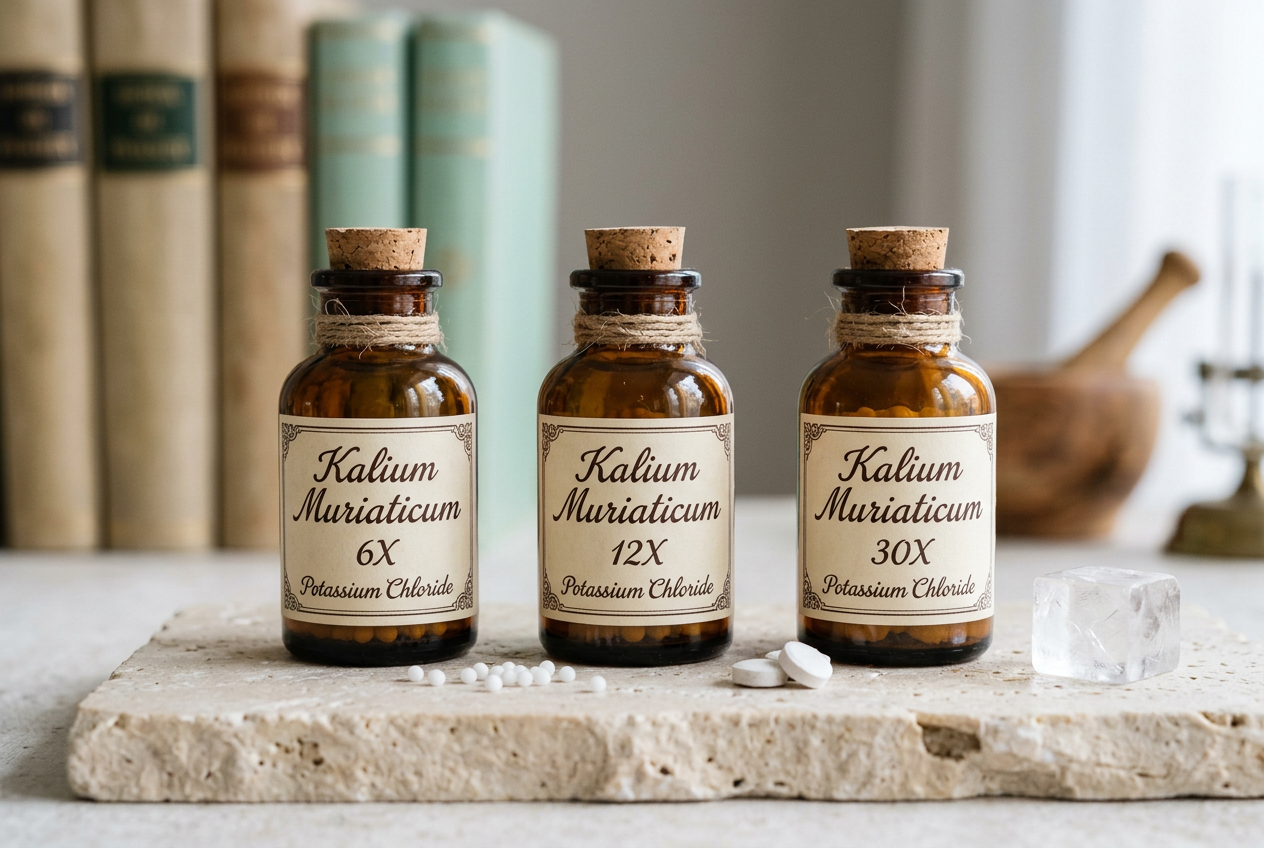
Available Preparations: 6X, 12X and 30X
Note on numbering: cell-salt numbering systems differ between manufacturers — Hyland’s, for example, numbers the salts in a different order from the classical Schüssler sequence. Always identify a preparation by its Latin name (e.g. Calcarea Sulphurica, Silicea), never by the number on the label alone.