WELLNESS & HEALTH · DR. HERMES, M.D.
Natrum Muriaticum — The Salt of Water Distribution
Of all the inorganic salts in the human body, only one governs the water that makes up nearly three-quarters of our tissues. It is common salt — not as a seasoning, but as a cell salt — and when it is deficient, the body’s entire water economy begins to break down.
What Is Natrum Muriaticum?
Natrum Muriaticum (Nat. mur.) is the eighth of the twelve inorganic tissue salts identified by Dr. Wilhelm Schüssler in the 1870s. Its chemical name is sodium chloride — the same compound as common table salt — but the cell salt is prepared through a process of serial trituration and dilution to the 6X homeopathic potency, rendering it a bioavailable mineral supplement rather than a condiment.
In the Schüssler-Carey system, each tissue salt corresponds to a specific physiological function. Natrum Muriaticum is the salt of water distribution. It governs the movement, retention, and elimination of water throughout the organism — a role that makes it indispensable to every cell, every tissue, and every organ.
Discovery in Human Ashes
When Schüssler analysed the mineral composition of human ashes, he found twelve inorganic salts essential to life. Among them, sodium chloride stood out in quantity second only to calcium phosphate. The body does not manufacture these salts; they must be supplied through diet and, when molecular motion is disturbed, through the administration of the corresponding cell salt in a prepared, assimilable form.
Dr. George W. Carey, writing in The Biochemic System of Medicine (1894), placed the water-distribution salt at the centre of his physiology:
“With the exception of the phosphate of lime, the human system contains more sodium chloride than any other inorganic salt. The reason for this may be readily understood when we realize that our bodies are about 70 per cent. water, which, in the absence of sodium chloride, would be inert and useless.”

Historical Doctrine: What Schüssler and Carey Taught
Carey’s description of sodium chloride is grounded in a single, clear principle: water, on its own, is biologically inert. It is the salt that gives water its utility.
“It is the power that this salt has to use water that renders it of any value to man. Sodium chloride uses water to build up and carry on the functions of life, and also as a vehicle to eliminate waste substances.”
When this salt is deficient, the consequences are immediate and widespread:
“Any deficiency in this cell-salt at once causes a disturbance of the water in the human organism, because it has lost that element which renders it fit to perform its allotted task.”
Carey identified two dramatic clinical conditions arising from a disturbance of the sodium chloride molecule. The first is sunstroke:
“In sun-stroke, a deficiency in sodium chloride allows the moisture to be drawn from other parts, especially the nape of the neck, and cause a pressure against the base of the brain, producing dangerous and sometimes fatal results. The above named salt, given in 3x or 6x, relieves the unpleasant condition called sun-stroke, surely and quickly.”
The second is delirium tremens, where the continuity of water itself is said to be disrupted:
“In delirium tremens, the continuity of water is broken up, due to a deficiency of sodium chloride molecules, and the symptoms incident to this disease follow. Very severe cases of delirium tremens have been relieved in one hour by administering frequent doses of this remedy.”
Carey summarised the diagnostic key with characteristic precision:
“The slimy, frothy appearance of the tongue, with watery secretions is the ‘key-note’ for this remedy. It regulates the proper degree of moisture of solids and proper amount of water of the fluids in the organism.”
And the tongue sign itself:
“Tongue has clear, slimy, watery coating, with small, frothy bubbles of saliva on the sides.”
What Natrum Muriaticum Treats (The Indications)
In the biochemic tradition, the indications for Natrum Muriaticum follow directly from its role as the water-regulating salt. The remedy is indicated wherever the body’s water balance is disturbed — either as an excess of watery secretions in one part with dryness in another, or as a generalised disturbance of the fluid economy.
Watery Secretions and Catarrhal States
Carey describes the Natrum Muriaticum picture as one of profuse, watery, frothy, and transparent secretions. These include:
– Clear, watery, transparent mucus from the nose with sneezing — fresh colds, hay fever, influenza
– Frothy, watery saliva and excessive drooling
– Profuse tears, especially with headaches or fresh colds
– Watery, frothy expectoration from the lungs — bronchitis, asthma with watery phlegm
– Watery diarrhoea, stools expelled with force, alternating with constipation
Headaches and Neurological Symptoms
Headaches of the Natrum Muriaticum type are characteristically accompanied by a paradoxical mixing of moisture and dryness:
– Headaches with profuse tears or watery vomiting
– Headaches with constipation and a frothy-coated tongue
– Sunstroke — the chief remedy, according to Carey
– Headaches of girls at puberty, with dullness and listlessness
– Headaches with vomiting of frothy, watery phlegm
Digestive and Metabolic Indications
– Indigestion with watery vomiting and a salty taste in the mouth
– Great craving for salt or salt foods
– Constipation from dryness of the mucous membranes of the bowels, with watery secretions elsewhere
– Emaciation while living well — a classical indication
– Chlorosis, the pale, sallow complexion of anaemia
Skin and Mucous Membrane Conditions
– Cold sores and fever blisters on the lips
– Eczema with white scales and watery exudation
– Urticaria (nettle-rash) appearing after becoming overheated
– Watery vesicles and blisters on the skin
– Dryness of one mucous membrane with excessive moisture in another
The Tongue Sign
The diagnostic hallmark, in Carey’s own words:
“Tongue has clear, slimy, watery coating, with small, frothy bubbles of saliva on the sides.”
This tongue appearance, together with the characteristic watery secretions, is what Carey calls the “key-note” for the remedy.

Where Conventional Care Plateaus: When a Specific Intervention Reaches Its Limit
The following cases come from the ABUGALY Holistic-Medical Institute. The research group reviewed real clinical scenarios in which conventional treatment reached a therapeutic plateau or produced harms that outweighed benefits, and where a biochemic approach, centred on Natrum Muriaticum, offered a constructive alternative.
The single salt, and when a combination is warranted
The protocols in this article prescribe one tissue salt — Natrum Muriaticum, the salt of this article — rather than a mixture. This is a deliberate choice of method, not an omission. The biochemic system is mineral-specific: each tissue salt corrects one discrete biochemical function, and one salt, correctly chosen and given time, removes the deficiency that holds the clinical picture in place. A single prescription is also traceable: when the patient improves, we know precisely which salt carried the signal. When several salts are given together, the signal is scattered, and neither the clinician nor the patient can tell which remedy was decisive.
For the great majority of plateau cases — where one dominant deficiency underlies the picture — the single salt is therefore the correct first prescription: D12 for the chronic state, D6 for the acute overlay, D30 for the stalled or long-suppressed case, reviewed at weeks 4, 8 and 12.
There is an honest exception, and the tradition itself recognises it. When a case presents with two or more distinct deficiencies at once — for example structural weakness together with nerve pain and acute inflammation — a multi-salt protocol is warranted. Schüssler himself combined the cell salts when the clinical picture demanded it. The single-salt prescription is therefore not a rule against combination; it is the discipline of starting with the dominant deficiency, observing the response, and adding a second salt only when the picture clearly requires it.
Case 1: Nasal Congestion — Oral Phenylephrine Plateau
A 47-year-old office worker presented with nasal congestion during a common cold. He experiences 4–5 colds per year and has mild seasonal allergic rhinitis, but no hypertension, cardiovascular disease, or prostate issues. For the current cold, he purchased oral phenylephrine 10 mg (single-ingredient tablets) at the pharmacy, taking one every 6 hours for six days. Despite six days of use, he reported no real improvement in nasal airflow, mouth breathing at night, disturbed sleep, and a mild headache. He asked the pharmacist for a “stronger version” of the same drug.
The research group reviewed the status of oral phenylephrine. On 11–12 September 2023, the FDA Nonprescription Drugs Advisory Committee voted unanimously 16–0 that oral phenylephrine is not effective at standard doses for nasal congestion. The FDA’s re-analysis of historical studies using modern methodology found no difference from placebo. The FDA announced its intention to propose removing oral phenylephrine from the OTC monograph. The drug also carries documented harms: hypertension, palpitations, and insomnia in sensitive subjects. Billions of doses are sold annually for an unproven effect, and its use delays adoption of measures that actually work — saline nasal washes, steam inhalation, and short-term topical decongestants (≤3–5 days).
What Dr. Hermes Would Propose: The biochemic approach addresses the terrain of the nasal mucosa rather than pursuing a drug that has been shown — by a unanimous FDA expert committee — to be indistinguishable from placebo. Natrum Muriaticum is the central salt for the nasal passages in the biochemic system: it governs the water balance of the mucous membranes, and its deficiency produces the very picture of nasal congestion, sneezing, and watery or alternately dry nasal mucosa that this patient presents. The protocol uses only Natrum Muriaticum across three potencies, selected according to the biochemic dilution doctrine:
Natrum Muriaticum D6 (acute/functional overlay): 1 tablet sublingually 3–4 times daily during the acute cold, 15 minutes away from food or coffee. The D6 potency addresses the functional disturbance of the nasal mucosa’s water regulation — the local, acute congestion. Continue until the cold resolves (typically 5–7 days).
Natrum Muriaticum D12 (chronic plateau/terrain): 1 tablet sublingually twice daily as maintenance for the underlying mild allergic rhinitis, continued for 8 weeks. The D12 potency is the default for chronic plateau states — the terrain that renders this patient susceptible to recurrent nasal congestion.
Natrum Muriaticum D30 (stalled/suppressed history): 1 tablet sublingually once daily, on alternate days, if the patient has a history of recurrent or suppressed colds where the deeper constitutional disturbance requires a higher potency. This is reserved for cases where the response to D6 and D12 stalls after 4 weeks.
Administration note: All potencies are taken sublingually, 15 minutes away from food or coffee. The oral phenylephrine should be stopped immediately — the FDA committee’s unanimous 16–0 vote confirms it is ineffective, and its continued use only delays effective care. Replace with saline nasal washes 2–3 times daily (evidence-based), steam inhalation, and adequate hydration. A topical decongestant (e.g., oxymetazoline) may be used for rapid relief but strictly limited to ≤3–5 days to avoid rhinitis medicamentosa. Review at weeks 4, 8, and 12 to assess the allergic rhinitis terrain and adjust the potency as needed.
Expected outcome: Nasal airflow improves within 1–2 days of stopping the ineffective oral phenylephrine and starting saline washes and steam. The acute cold resolves within the natural 5–7 day course. Over 4–8 weeks of Natrum Muriaticum D12 maintenance, the patient should experience fewer and less severe episodes of nasal congestion with subsequent colds and a reduction in the allergic rhinitis background. No exposure to the cardiovascular and insomnia risks of oral phenylephrine. The patient is educated on which OTC products to avoid in the future.
Case 2: Lumbar Spinal Stenosis — Epidural Corticosteroid Plateau
A 72-year-old retired woman presented with MRI-confirmed lumbar spinal stenosis at L4-L5, with neurogenic claudication of two years’ duration. Her walking tolerance had fallen to approximately 200 metres before bilateral leg pain and heaviness forced her to stop, relieved only by bending forward or sitting. She had night cramps, sleep disturbance, and significant frustration. A specialist proposed a series of three epidural corticosteroid injections (triamcinolone plus lidocaine) over three months, with the promise of postponing surgery. No exercise programme, manual therapy, or education about walking-with-flexion strategies was offered first.
The research group reviewed the evidence. A double-blind RCT of 400 patients with lumbar spinal stenosis (Friedly et al., N Engl J Med 2014) showed that epidural glucocorticoid plus lidocaine was no better than lidocaine alone for disability and pain at 3 and 6 weeks — the corticosteroid component added no benefit. The procedure carries real risks: dural puncture, epidural haematoma, infection, nerve injury, and systemic steroid effects from repeated exposure including hyperglycaemia, adrenal suppression, and bone loss. The patient was being offered a procedure with no proven added benefit over a simpler injection, with documented harms, and without a trial of guideline-based conservative care.
What Dr. Hermes Would Propose: The biochemic approach for lumbar stenosis focuses on the terrain of the connective and nervous tissues, with Natrum Muriaticum as the central salt for water regulation in the spinal canal and the surrounding structures. The oedematous component of spinal stenosis — the intermittent swelling and fluid congestion that compresses nerve roots during walking — is, in the biochemic view, a disturbance of the water-distribution salt. The protocol uses only Natrum Muriaticum across three potencies, selected according to the biochemic dilution doctrine:
Natrum Muriaticum D12 (chronic plateau/terrain): 1 tablet sublingually three times daily, 15 minutes away from food or coffee. The D12 potency is the default for chronic/degenerative plateau states — the foundational salt for water regulation in the spinal tissues, addressing the fluid congestion that contributes to neurogenic claudication. Continue for 12 weeks, then reassess.
Natrum Muriaticum D6 (acute/functional overlay): 1 tablet sublingually up to 4–6 times daily during acute symptom flares — cramping episodes, acute discomfort, or periods of increased neurogenic pain. The D6 potency addresses the local, functional overlay on the chronic terrain.
Natrum Muriaticum D30 (stalled/suppressed history): 1 tablet sublingually once daily, on alternate days, if the case stalls after the initial 4–8 week trial — the walking tolerance fails to improve, or there is a history of suppressed inflammatory responses that requires a deeper constitutional intervention.
Administration note: All potencies are taken sublingually, 15 minutes away from food or coffee. Review at weeks 4, 8, and 12 to assess progress and adjust the potency as needed. The first-line intervention is not an injection series but guideline-based conservative care: supervised therapeutic exercise, walking-with-flexion strategies, patient education about the condition, and manual therapy as tolerated. The epidural steroid series should be declined unless and until these measures have been tried and found insufficient. The cell salt supports the tissues during this conservative trial. Red flags (cauda equina syndrome) must be reviewed and documented.
Expected outcome: Over 8–12 weeks, the patient should experience gradual improvement in walking tolerance and a reduction in night cramps and sleep disturbance, without exposure to procedural or steroid risks. The goal is functional improvement sufficient to postpone or avoid surgical intervention, with the decision made only after a full conservative trial.
Clinical References for the Three Cases
- FDA, Nonprescription Drugs Advisory Committee meeting, 11–12 September 2023 — unanimous 16–0 vote: oral phenylephrine not effective at recommended doses; FDA statement on intention to propose removal from the OTC monograph.
- Friedly JL, et al. A randomized trial of epidural glucocorticoid injections for spinal stenosis. N Engl J Med. 2014;371(1):11-21. PMID: 24988555.
- Carey GW. The Biochemic System of Medicine. 1894. (Natrum Muriaticum section, pp. 100–107).
- Schüssler WH. Eine abgekürzte Therapie, gegründet auf Histologie und Cellular-Pathologie. 1873.
- Boericke W, Dewey WA. The Twelve Tissue Remedies of Schüssler. 1898.
Dosage and Potency
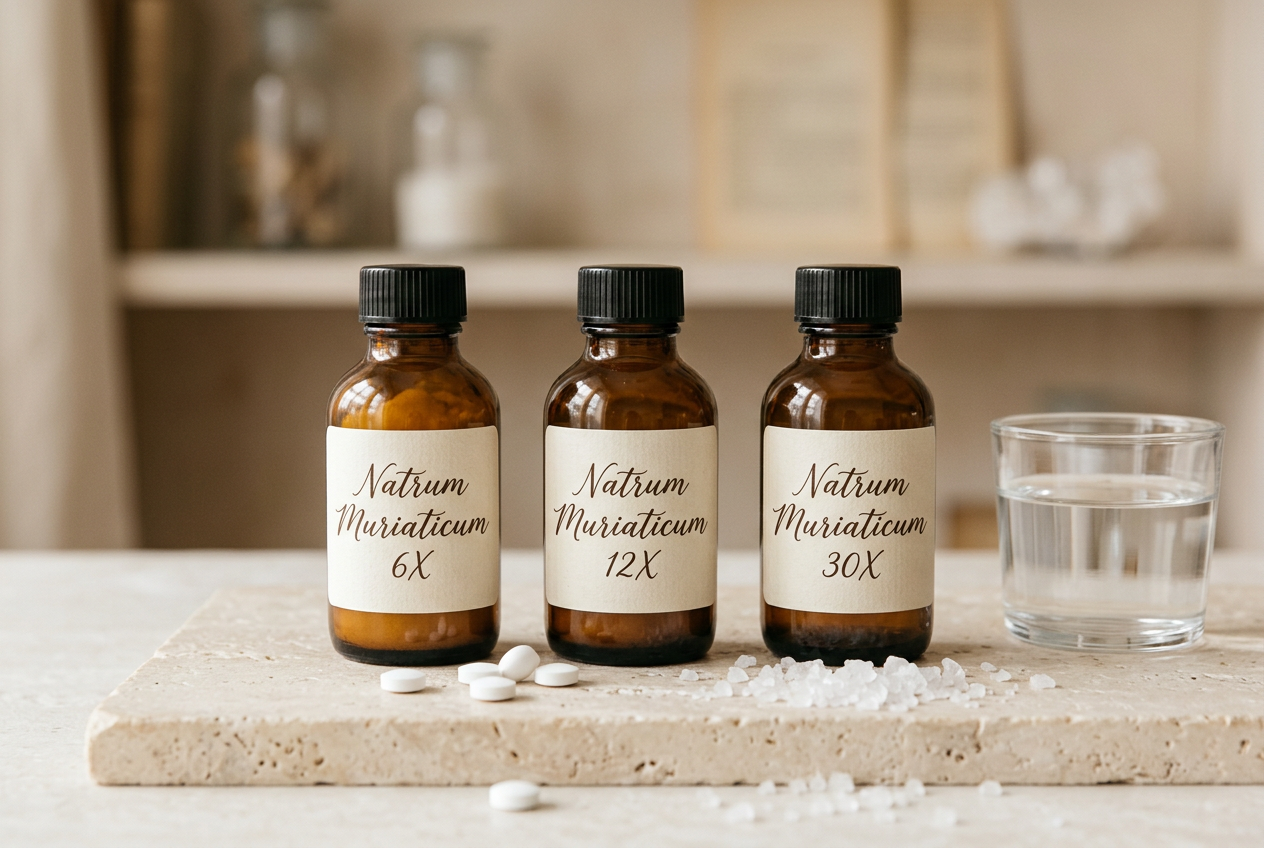
Natrum Muriaticum is prepared in the Schüssler-Carey tradition as a triturated cell salt. The standard potencies are:
- 6X (D6): The most commonly used potency for general tissue support. Each tablet contains the one-millionth part of a grain of the cell salt. Suitable for ongoing constitutional therapy, taken 1 tablet sublingually 3–4 times daily, 15 minutes away from food or drink.
- 12X (D12): A higher potency, often used when the indications are more clearly defined or when the 6X response has been partial. Taken 1 tablet sublingually 2–3 times daily.
- 30X (D30): The highest of the commonly used potencies. Reserved for more deep-seated or chronic conditions, taken 1 tablet sublingually once daily or on alternate days.
All potencies are taken by allowing the tablet to dissolve under the tongue. Avoid eating, drinking, or brushing teeth for 15 minutes before and after administration. The tablets contain lactose as a base; those with lactose intolerance should consult their practitioner.
Final Thoughts
Natrum Muriaticum is, in many ways, the most intuitive of the twelve tissue salts. The idea that common salt regulates water in the body is not only correct — it is fundamental physiology. The nineteenth-century physicians correctly identified that disturbances in water balance produce headaches, watery discharges, oedema, and electrolyte-related symptoms. What Carey and Schüssler added was a systematic method for addressing these disturbances at the cellular level, using the very salt that nature employs for the same purpose.
In the modern context, where patients are often offered pharmaceutical interventions that suppress symptoms without addressing the underlying terrain, the biochemic approach offers a gentle, physiological alternative. When conventional care reaches its limit — when the oral decongestant offers no benefit over placebo, or when the epidural steroid series offers no benefit over a sham injection — the tissue salts invite us to step back and ask a different question: not “what symptom can we suppress?” but “what cell salt is the tissue lacking?”
For the water-regulating salt, the answer is written in the tongue, in the tears, in the saliva, and in the ebb and flow of the body’s fluids. It is the salt of water distribution — and when the waters are disturbed, it is the salt that restores the balance.
Dr. Hermes Trismegistus, M.D.
Doctorate in Schüssler Biochemic Medicine · Chief Medical Scholar, ABUGALY Holistic-Medical Institute
Books for Further Study
- Carey GW. The Biochemic System of Medicine — Buy on Amazon
- Schüssler WH. An Abridged Therapy — Buy on Amazon
- Boericke W, Dewey WA. The Twelve Tissue Remedies of Schüssler — Buy on Amazon
- Chapman & Perry. The Biochemic Handbook — Buy on Amazon
- Carey GW. The Chemistry of Human Life — Buy on Amazon
- Strbac L. Schuessler’s Tissue Salts Rediscovered — Buy on Amazon
- Chapman J. B., M.D. Dr. Schuessler’s Biochemistry — Buy on Amazon
- Roberts M. Tissue Salts for Healthy Living — Buy on Amazon
- Weintraub S., N.D. Natural Healing with Cell Salts — Buy on Amazon
- Jacka J. The Handbook of Biochemic Tissue Salts — Buy on Amazon
Available Preparations: 6X, 12X and 30X
Note on numbering: cell-salt numbering systems differ between manufacturers — Hyland’s, for example, numbers the salts in a different order from the classical Schüssler sequence. Always identify a preparation by its Latin name (e.g. Calcarea Sulphurica, Silicea), never by the number on the label alone.