WELLNESS & HEALTH · DR. HERMES, M.D.
Silicea — The Purifying Salt of Structure and Elimination
The eleventh of the twelve cell salts of the Schüssler system, Silicea governs the integrity of connective tissue, the elimination of deep-seated waste, and the structural repair of skin, hair, nails, and tendons. Its history reaches from the ashes of human bone to the operating theatre — where modern evidence now questions the very surgeries that once seemed unavoidable.
What Is Silicea?
Silicea — also known as Silica, Silicon Dioxide, or Silicious Earth — is the eleventh cell salt of Dr. Wilhelm Schüssler’s biochemic system. It is the salt of structure and elimination, found principally in the connective tissue, the periosteum (the membrane that surrounds bone), the neurilemma (the sheath of nerve fibres), the skin, hair, and nails.
In the biochemic view, the role of Silicea is twofold: to maintain the architectural integrity of the tissues that give the body its form, and to marshal the expulsion of decaying organic matter — what the nineteenth-century texts call heteroplasm — from deep within the organism. When Silicea is abundant, wounds heal cleanly, abscesses discharge promptly, and the connective tissue conducts the vital currents of the nervous system without interference. When it is deficient, repair stalls, suppuration lingers, and the body struggles to cast off what it no longer needs.
Discovery in Human Ashes
Like the other eleven tissue remedies, Silicea was identified through the careful incineration of human tissue. When the body is reduced to its mineral ash, silica remains — a testament to its role as a fundamental structural component. Schüssler, working from the cellular pathology of Rudolf Virchow, reasoned that if a substance is present in healthy tissue, its deficiency must underlie the disordered function of that tissue. From this principle, the biochemic system was born.
Silicea is the eleventh of the twelve tissue salts in Schüssler’s system. It is the only salt whose primary component — silicon — is not a metal but a metalloid, occupying a unique place among the tissue remedies as the guardian of the body’s architectural scaffolding.

Historical Doctrine: What Schüssler and Carey Taught
Dr. George W. Carey, in The Biochemic System of Medicine (1894), devoted an entire chapter to Silicea. His account is remarkable for its vivid, almost mechanistic imagery of how silica works in the body:
“This salt is indicated in all suppurative processes until the infiltrated parts have fully discharged the heteroplasm or accumulation of decaying organic matter that may have arrived at a given point during nature’s effort to eliminate it from the system.”
Carey went further, advancing a strikingly literal theory of Silicea’s action in suppuration:
“My theory is, that the particles of silica, being sharp-cornered, accumulate under the intelligent operations of nature’s law of affinity or attraction and act as a lancet, thus cutting away through the tissue, skin, etc., for the escape of the non-functional organic matter. But in order to carry on any work, nature must have tools to work with. When silica is present in proper quantities, the process of suppuration is carried on in a normal manner. When a deficiency of silica occurs, suppuration is retarded; the greater the deficiency, the greater and more stubborn and painful the swelling or part at which the matter is attempting to escape.”
This was not merely a poetic metaphor. Carey drew a direct causal line from Silicea deficiency to specific diseases:
“Thus it will be seen that a lack of silica (one of the natural mineral salts of human blood) is the cause of carbuncles, and not the anthrax bacillus.”
He also described a mental dimension to Silicea deficiency that is among the most distinctive in the materia medica:
“A deficiency of silica in the connective tissue between the cerebrum and cerebellum produces a mental condition in which thinking is difficult. But why? Because the connective tissue has become so negative from the lack of silica that it fails to act as a conductor for the grey matter of the brain (a combination of potassium phosphate and albumen). By supplying silica in molecular form, the chemical affinity is restored and normal thought again established.”
The mental symptoms Carey recorded include: “Patient rather despondent and disgusted with life. Mental abstraction; difficulty of thought.”
Schüssler himself, working two decades earlier in Oldenburg, had identified Silicea as the specific inorganic salt of the connective tissue cells — the matrix through which capillaries carry plasma from blood to tissue and back, and the breeding ground for young cells. Where the connective tissue is impoverished in silica, the whole economy of cellular nutrition suffers.
What Silicea Treats (The Indications)
The classical materia medica of Silicea, drawn from the clinical observations of Schüssler, Carey, and their contemporaries, covers a broad territory unified by the salt’s role in structural integrity and eliminative processes:
Suppuration and Abscess
Silicea is the great remedy for the third stage of inflammation — when pus has formed and the body needs to discharge it. Carey’s sequencing is precise: Ferrum Phosphoricum for the first (inflammatory) stage, Kalium Muriaticum for the second (swelling without pus), and then Silicea once suppuration has commenced. “It greatly assists suppuration, causes the abscess to ripen and often break without surgical interference.”
Skin, Hair, and Nails
Silicea is the classical remedy for recurrent boils, especially in spring; styes that will not come to a head; slow-healing wounds; brittle nails; and unhealthy skin that suppurates easily after minor injuries. The discharge characteristic of Silicea is thick, yellow, and heavy — “pus falls to the bottom of the vessel.”
Bone and Periosteum
“Silicea is indicated in nearly all bone diseases,” Carey writes, “the chief symptom calling for its use is the thick, yellow, offensive, mattery discharge from ulceration of the bone.” It is the remedy of choice in hip-joint disease, caries of bone, and neglected injuries that threaten to suppurate deeply.
Connective Tissue and Tendons
As the salt of the connective tissue matrix, Silicea supports the repair of tendons, ligaments, and the fascial sheaths that envelop every muscle and organ. In the case protocols of the ABUGALY Holistic-Medical Institute, it appears as the foundational repair-support salt for rotator cuff and shoulder impingement — the salt that underpins the structural healing of the shoulder girdle.
Ears, Nose, and Throat
Suppurative otitis with thick yellow discharge; catarrh with foetid, thick yellow matter; ozaena seated in the periosteum or submucous connective tissue; ulcerations of the throat with thick, mattery discharges — all call for Silicea.
Glandular and Lymphatic
Suppurating glands, scrofulous enlargements, indurations after boils, and fistulous openings all respond to Silicea when the discharge is thick and yellow.
Modalities
The characteristic modifying factors for Silicea are among the most reliable in the repertory: worse at night and during full moon; better by heat and in a warm room; worse from suppressed foot-sweat or chilling of the feet; worse in open air.
Where Conventional Care Plateaus: When a Specific Intervention Reaches Its Limit
The following cases come from the ABUGALY Holistic-Medical Institute. The research group reviewed two orthopaedic scenarios in which the standard surgical intervention — widely performed and routinely recommended — has been shown by high-quality evidence to offer little or no clinically important benefit over more conservative approaches. In both, the biochemic support of connective tissue and tendon repair provides a rational complement to structured rehabilitation.
The single salt, and when a combination is warranted
The protocols in this article prescribe one tissue salt — Silicea, the salt of this article — rather than a mixture. This is a deliberate choice of method: each tissue salt corrects one discrete biochemical function, and a single prescription is traceable — when the patient improves, we know precisely which salt carried the signal. For most plateau cases the single salt is therefore the correct first prescription: D12 for the chronic state, D6 for the acute overlay, D30 for the stalled or long-suppressed case, reviewed at weeks 4, 8 and 12. There is an honest exception, and the tradition itself recognises it: when a case presents with two or more distinct deficiencies at once, a multi-salt protocol is warranted — Schüssler himself combined the cell salts when the clinical picture demanded it. The single-salt prescription is therefore not a rule against combination; it is the discipline of starting with the dominant deficiency and adding a second salt only when the picture clearly requires it.
Case 1: Arthroscopic Subacromial Decompression for Shoulder Impingement
Patient profile: A 55-year-old office manager and recreational tennis player presented with eight months of right shoulder pain, insidious onset, no trauma. Pain was provoked by overhead activities and at night when lying on the affected shoulder. MRI showed intact rotator cuff tendons, subacromial bursitis, and an acromial spur. She had completed a twelve-week physiotherapy programme and received one subacromial corticosteroid injection, which provided only transient relief. The orthopaedic surgeon proposed arthroscopic subacromial decompression (ASD) — removal of the spur and bursa.
The standard intervention: Arthroscopic subacromial decompression is one of the most common orthopaedic procedures worldwide, performed for shoulder impingement syndrome when conservative care fails. Two landmark placebo-surgery-controlled trials have now examined its efficacy.
CSAW trial (Beard et al., Lancet 2018): 313 patients randomised to decompression, arthroscopy-only (sham surgery), or no treatment. The primary outcome — the Oxford Shoulder Score (0–48) at six months — showed a mean difference of only −1.3 points between decompression and arthroscopy-only (95% CI −3.9 to 1.3; p=0.31), far below the clinically important threshold of 4.5 points. The authors concluded that decompression offered “no extra benefit over arthroscopy only.”
FIMPACT trial (Paavola et al., BMJ 2018): 210 patients randomised to ASD, diagnostic arthroscopy (sham), or exercise therapy. At 24 months, pain VAS showed no clinically relevant difference between ASD and sham: −4.6 (95% CI −11.3 to 2.1) at rest and −9.0 (95% CI −18.1 to 0.2) on activity. The conclusion: “arthroscopic subacromial decompression provided no benefit over diagnostic arthroscopy at 24 months.”
Documented harms include general anaesthesia, infection, postoperative stiffness (six frozen shoulders in the CSAW trial alone), haematoma, portal-site pain, and work absence. Remarkably, 23% of patients assigned to decompression in the CSAW trial had not received surgery by six months — without worse outcomes, suggesting that time plus conservative care works as well as the knife.
What Dr. Hermes would propose: A structured conservative programme — supervised progressive shoulder exercise (rotator cuff strengthening, scapular control, range of motion) continued for eight to twelve weeks — supported by a biochemic protocol targeting the connective tissue terrain of the shoulder girdle.
Dr. Hermes Protocol — Shoulder Impingement
- Silicea D12: 1 tablet sublingual 2×/day (morning, evening), course 12 weeks — supports tendon and connective-tissue trophism of the rotator cuff and subacromial space. D12 is the default plateau potency for chronic tissue-repair states.
- Silicea D6: 1 tablet sublingual 1×/day (midday) for the first 4 weeks, then as needed during pain flares — the acute overlay potency for the subacromial inflammatory component.
All tablets dissolved sublingually, 15 minutes away from food, coffee, or strong flavours. Reassess at weeks 4, 8, and 12. Structured exercise programme is the decisive intervention; the biochemic protocol supports the terrain.
Case 2: Rotator Cuff Repair for Degenerative Full-Thickness Tear
Patient profile: A 61-year-old retired builder presented with eight months of right shoulder pain, worse at night and with overhead activity. MRI revealed a full-thickness tear of the supraspinatus tendon (~1.5 cm, retracted less than 1 cm), no subscapularis involvement, no traumatic onset. The orthopaedic surgeon proposed arthroscopic rotator cuff repair “before the tear gets bigger.”
The standard intervention: Arthroscopic rotator cuff repair — with or without subacromial decompression — is one of the most common orthopaedic operations worldwide. The Cochrane Collaboration examined the evidence in a 2019 systematic review.
Cochrane review (Karjalainen et al., Cochrane Database of Systematic Reviews 2019): 9 randomised controlled trials involving 1,007 participants with full-thickness tears, mostly small degenerative supraspinatus tears, mean age 56–68 years. At one year, the primary comparison of surgery versus non-operative treatment showed: pain (0–10 scale) was 1.6 with non-operative treatment and only 0.87 points better with surgery (95% CI 0.43–1.30; moderate certainty) — below the threshold of clinical relevance. Function (0–100 scale) was 72 with non-operative treatment and 6 points better with surgery (95% CI 2.43–9.54; low certainty). Participant-rated global success was 873 per 1,000 with non-operative treatment versus 943 per 1,000 with surgery — a relative risk of 1.08 (95% CI 0.96–1.22; low certainty, not statistically significant). Health-related quality of life was actually 1.3 points worse with surgery (one trial, 103 participants). Adverse events could not be reliably estimated due to under-reporting.
The authors concluded that rotator cuff repair probably provides little or no clinically important benefit on pain, function, quality of life, or global success at one year compared with non-operative treatment.
What Dr. Hermes would propose: A proper conservative trial of six to twelve months of structured progressive exercise, supported by a biochemic protocol designed to support tendon repair from within. Surgery is reserved for failure of well-conducted conservative care, traumatic tears in young patients, or specific occupational needs.
Dr. Hermes Protocol — Rotator Cuff Tear (Degenerative)
- Silicea D12: 1 tablet sublingual 1×/day (morning), course 12 weeks — the classical salt for connective-tissue and tendon repair. D12 is the default plateau potency for chronic tissue-repair states.
- Silicea D30: 1 tablet sublingual 1×/day (evening), course 8 weeks — the deeper constitutional potency for degenerative tendon states where repair has stalled.
All tablets dissolved sublingually, 15 minutes away from food, coffee, or strong flavours. Reassess at weeks 4, 8, and 12. Six to twelve months of structured progressive exercise is the first step; surgery is deferred pending the outcome of conservative care.
Clinical References for the Two Cases
- Beard DJ, Rees JL, Cook JA, et al. Arthroscopic subacromial decompression for subacromial shoulder pain (CSAW): a multicentre, pragmatic, parallel group, placebo-controlled, three-group, randomised surgical trial. Lancet. 2018;391(10118):329-338. PMID: 29169668.
- Paavola M, Malmivaara A, Taimela S, et al. Subacromial decompression versus diagnostic arthroscopy for shoulder impingement: randomised, placebo surgery controlled clinical trial (FIMPACT). BMJ. 2018;362:k2860. PMID: 30026230.
- Karjalainen TV, Jain NB, Heikkinen J, Johnston RV, Page CM, Buchbinder R. Surgery for rotator cuff tears. Cochrane Database Syst Rev. 2019;12(12):CD013502. PMID: 31813166.
- Carey GW. The Biochemic System of Medicine. 1894. (Silicea materia medica, pp. 119–127.)
- Schüssler WH. Eine abgekürzte Therapie, gegründet auf Histologie und Cellular-Pathologie. 1873.
- Boericke W, Dewey WA. The Twelve Tissue Remedies of Schüssler. 1898.
Dosage and Potency
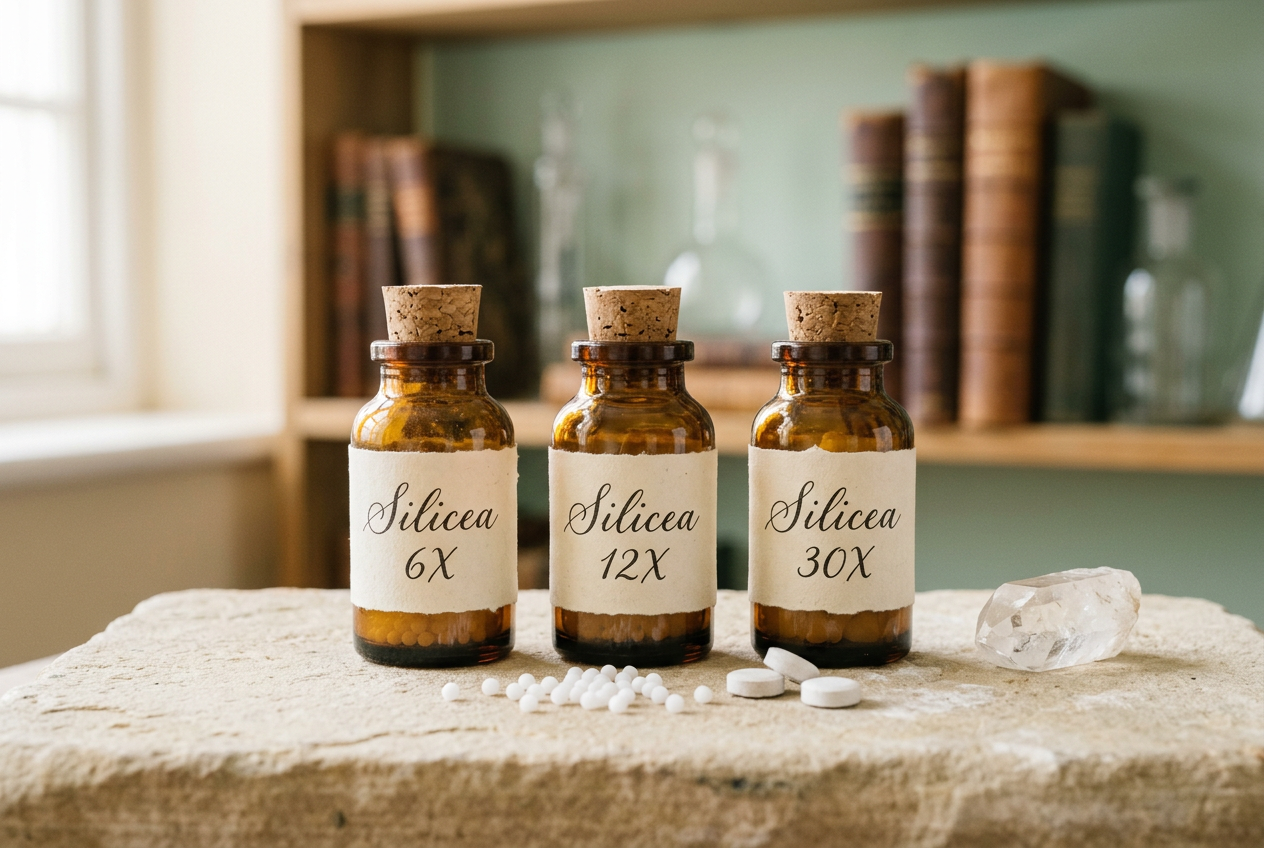
Silicea is most commonly used in the 6X, 12X, and 30X potencies. The 6X (or 6C) potency is the standard for acute suppurative conditions — boils, styes, and slow-healing wounds — and may be taken 1 tablet sublingually, 3 to 4 times daily, away from meals. For chronic conditions involving connective tissue, tendons, or bone, the 12X potency is preferred, taken 1 to 2 tablets daily over a course of eight to twelve weeks. The 30X potency is reserved for deeper, more constitutional states and for patients who are particularly sensitive to the lower potencies.
In acute suppurative conditions, more frequent dosing (every 2 to 3 hours) may be employed for short periods. The tablets should be allowed to dissolve completely under the tongue, at least 15 minutes before or after food, drink, or coffee. A course of four to eight weeks is typical for chronic conditions, with reassessment at regular intervals.
Final Thoughts
Silicea is the salt I reach for most often in my own family. The stye that will not come to a head, the splinter that festered, the teenager’s back that is a battlefield of deep, painful acne — Silicea has a real place in the home medicine cabinet. The modern nutritional research on silicon for hair, nails, and skin only strengthens the case.
The “night aggravation” pattern is one of the most reliable in the entire repertory. If a boil, abscess, or joint pain hurts more at night, in bed, under the warmth of the covers — that is the signature of Silicea. It is the salt that works while the body is still, bringing to the surface what must be expelled.
What the two orthopaedic cases above illustrate is a broader truth: that the body’s own structural intelligence, when properly supported, often accomplishes what the surgeon’s knife promises but does not always deliver. The placebo-surgery trials are a humbling reminder that the effect attributed to an operation is sometimes the body healing itself — with time, with structured movement, and with the right biochemical terrain. Silicea, the salt of structure and elimination, is part of that terrain.
Dr. Hermes Trismegistus, M.D.
Doctorate in Schüssler Biochemic Medicine · Chief Medical Scholar, ABUGALY Holistic-Medical Institute
Books for Further Study
- Carey GW. The Biochemic System of Medicine. — View on Amazon
- Schüssler WH. An Abridged Therapy: Manual of Biochemical Treatment. — View on Amazon
- Boericke W, Dewey WA. The Twelve Tissue Remedies of Schüssler. — View on Amazon
- Chapman JB, Perry EG. The Biochemic Handbook. — View on Amazon
- Carey GW. The Chemistry of Human Life. — View on Amazon
- Strbac L. Schuessler’s Tissue Salts Rediscovered. — View on Amazon
- Hering C. The Twelve Tissue Remedies, of Dr. Schüssler, Recommended for Investigation (1874) — an early American examination of the tissue salts by the father of American homeopathy. View on Amazon
- Chapman JB, M.D. Dr. Schuessler’s Biochemistry. — View on Amazon
- Roberts M. Tissue Salts for Healthy Living. — View on Amazon
- Weintraub S., N.D. Natural Healing with Cell Salts. — View on Amazon
Available Preparations: 6X, 12X and 30X
Note on numbering: cell-salt numbering systems differ between manufacturers — Hyland’s, for example, numbers the salts in a different order from the classical Schüssler sequence. Always identify a preparation by its Latin name (e.g. Calcarea Sulphurica, Silicea), never by the number on the label alone.