WELLNESS & HEALTH · DR. HERMES, M.D.
Calcarea Sulphurica — The Cleansing Salt of the Deeper Tissues
Calcium sulphate — the twelfth and final of the twelve tissue remedies — governs the closing phase of every suppurative process. Where Silicea ripens, Calcarea Sulphurica heals. An exploration of the salt that cleans the debris of inflammation and restores the tissues to wholeness.
What Is Calcarea Sulphurica?
Calcarea Sulphurica (calcium sulphate, CaSO₄) is the twelfth and final of the twelve tissue remedies identified by Dr. Wilhelm Schüssler in the 1870s. Known in the material world as gypsum or plaster of Paris, this mineral salt plays a specific role in the human economy: it governs the closing stage of suppuration — the moment when pus has been discharged, the debris of inflammation must be cleared, and the tissues must be restored to their normal state.
In Schüssler’s system, each of the twelve cell salts is a vital inorganic worker in the cellular economy. A deficiency of any one salt produces a characteristic pattern of disturbance. Calcarea Sulphurica is the salt that, when present in proper quantity, ensures that the healing process concludes properly — that wounds close, discharge ceases, and epithelial cells regenerate rather than break down.
It is the complementary salt to Silicea: Silicea brings a suppurative process to a head; Calcarea Sulphurica closes it afterwards. The two are often used in sequence — a partnership that is one of the most elegant in the biochemic system.
Discovery in Human Ashes
Schüssler’s method was grounded in the chemical analysis of human ashes. By identifying the inorganic salts that remain after organic matter is consumed, he determined which minerals are essential constituents of the body. Calcium sulphate was found among these residues — a small but indispensable component of the cellular structure.
Where other calcium salts govern bone formation (Calcarea Phosphorica) and elastic tissue integrity (Calcarea Fluorica), Calcarea Sulphurica is assigned to the epithelial cells and the resolution of suppurative processes. Its presence in human ashes confirmed that the body requires this specific sulphate of lime for the proper completion of the inflammatory cycle.

Historical Doctrine: What Schüssler and Carey Taught
Dr. George W. Carey, in The Biochemic System of Medicine (1894), devoted a full chapter to Calcarea Sulphurica. His description of its action remains the clearest statement of the salt’s therapeutic role:
“SULPHATE OF LIME is used to clean out an accumulation of heteroplasm in the interstices of tissue; to cause the infiltrated parts to discharge their contents readily, and throw off decaying organic matter, so it may not lay dormant or slowly decay, and thus injure the surrounding tissue.”
He then states the central deficiency symptom with characteristic directness:
“A lack of this salt allows suppuration to continue too long. It controls suppuration. A decay of epithelial cells, after the infiltrated parts have discharged their contents, indicates a lack of this salt.”
Carey identifies the specific clinical territory of the salt:
“The third stage of all catarrhs, lung troubles, boils, carbuncles, ulcers or abscesses need this cell-salt.”
He then draws the crucial distinction between Calcarea Sulphurica and its complementary salt, Silicea:
“While silica hastens the process of suppuration in a normal manner, Calc. sulph. closes up the process at the proper time if it is present in the blood in proper quantity.”
Carey explains the mechanism of action in his own physiological terms:
“I have been asked why Calc. sulph. prevented the process or so promptly closes it up. I answer: Simply because a lack of this vitalizer — inorganic worker in organic matter — allows the epithelial cells to breakdown — allows tissue to disintegrate; then the fluids from the blood (serum) take up the waste and carry it off through some natural or artificial orifice.”
And he concludes with a statement of the salt’s primacy in suppurative conditions:
“Other salts, of course, are of some importance in such conditions, but in true suppurations Calc. sulph. is always the chief remedy, because there can be no true suppuration when this worker is present in proper quantity. The success I have had with this salt has been surprising.”
These passages, drawn from pages 63–65 of the 1894 edition, constitute the core historical doctrine of Calcarea Sulphurica. The teaching is consistent across all subsequent biochemic texts: this is the salt that closes the door on suppuration.
What Calcarea Sulphurica Treats (The Indications)
The materia medica of Calcarea Sulphurica, as compiled by Carey and the broader Schüssler tradition, organises its indications by the character of the discharge and the stage of the inflammatory process. The following are the principal indications:
Throat and Respiratory
- All ailments of the throat in the third stage of inflammation, or when discharging mattery secretions
- Sore throat, quinsy and tonsillitis, when suppurating, or before matter has formed, to prevent its formation
- Last stages of consumption, when the expectoration is purulent, mattery and sometimes bloody
- Last stage of croup, pneumonia or bronchitis; generally indicated after Kalium Muriaticum
- Pus forming in the cavity of the lung or pleura
Skin and Wounds
- Skin affections with yellow scabs; pimples when discharging matter
- Boils, to abort them or to control suppuration after they have opened
- Neglected wounds, cuts, etc., when discharging pus and when they do not heal readily
- Burns and scalds (after Kalium Muriaticum), when suppurating
- Crusta lactea (scald-head), with yellow crusts or secretions
- In all cases of suppuration, when the discharge continues too long and the sore is unhealthy
Ears, Eyes, Nose
- Discharges from the ear: thick, yellow, sometimes mixed with blood
- Inflammation of the eyes, when pus is discharging; abscess of the cornea; hypopyum
- Colds in the head in the third stage or stage of resolution, when the discharge is thick, yellow, purulent and sometimes tinged with blood
- Chronic catarrh of the head, with purulent discharge from the anterior or posterior nares
Mouth and Teeth
- Mattery pimples on the face; pimples at the age of puberty, when matter forms
- Tender pimples under the beard, with purulent bloody secretions
- Ulceration at the roots of the teeth, with swelled gums and cheeks
Abdomen and Glands
- Discharge of matter, or blood and matter from the bowels
- Abscess of the liver, with purulent discharge
- Suppurations and ulcerations of the glands
- Suppurating abscess of the prostate gland
Modality
The characteristic modality of Calcarea Sulphurica is: worse from getting wet; better in a warm, dry atmosphere. Carey notes that a warm, dry environment will greatly assist the action of the remedy.
Where Conventional Care Plateaus: When a Specific Intervention Reaches Its Limit
The following cases come from the ABUGALY Holistic-Medical Institute. The research group reviewed instances where standard medical interventions reached their therapeutic limit — not because the intervention is ineffective in the acute sense, but because the underlying pattern of recurrent or prolonged suppuration was not addressed. In each case, the biochemic approach offers a complementary path that supports the body’s own closing phase of the inflammatory process.
The single salt, and when a combination is warranted
The protocols in this article prescribe one tissue salt — Calcarea Sulphurica, the salt of this article — rather than a mixture. This is a deliberate choice of method: each tissue salt corrects one discrete biochemical function, and a single prescription is traceable — when the patient improves, we know precisely which salt carried the signal. For most plateau cases the single salt is therefore the correct first prescription: D12 for the chronic state, D6 for the acute overlay, D30 for the stalled or long-suppressed case, reviewed at weeks 4, 8 and 12. There is an honest exception, and the tradition itself recognises it: when a case presents with two or more distinct deficiencies at once, a multi-salt protocol is warranted — Schüssler himself combined the cell salts when the clinical picture demanded it. The single-salt prescription is therefore not a rule against combination; it is the discipline of starting with the dominant deficiency and adding a second salt only when the picture clearly requires it.
Case 1: Recurrent Tonsillitis in Childhood — When the Scalpel Does Not Address the Pattern
Case ID: TRAIN-2026-047
A 7-year-old boy presented with seven episodes of acute tonsillitis in the preceding twelve months, four of which were confirmed group A streptococcal infections. Each episode was treated with amoxicillin. The child missed 18 school days. The ENT specialist proposed tonsillectomy, citing the guideline threshold of seven episodes in one year. The parents were hesitant — anxious about removing what they understood to be an immune organ, and fearful of the postoperative pain and haemorrhage risk.
The research group reviewed the evidence. The Cochrane review (Burton & Glasziou, 2014, PMID 25407135) found that tonsillectomy reduces sore throat episodes by approximately one episode per year in the first postoperative year, with the benefit fading over time and no demonstrated long-term quality-of-life gain. NICE guideline NG84 restricts referral to severe, well-documented cases — and even within these criteria, the benefit is modest. The documented harms include postoperative haemorrhage (1–5% of children, up to 10% in adults), 7–14 days of severe throat pain, dehydration risk, and anaesthesia risk.
What Dr. Hermes Would Propose: In this case, the conventional approach addresses each acute episode with antibiotics and then proposes surgical removal of the organ itself. The biochemic approach instead asks: what supports the resolution phase of each episode so that the throat tissues close the process properly and the interval between episodes lengthens? Calcarea Sulphurica is the salt of the third stage of inflammation — the stage at which the infiltrated tissues must discharge their contents and close. By supporting this resolution phase, the remedy may reduce the severity and duration of each episode, and thereby reduce the cumulative burden that leads to the surgical threshold.
Dr. Hermes Protocol — Recurrent Tonsillitis
- Calcarea Sulphurica D12 — 1 tablet sublingual, twice daily, 15 minutes away from food, as chronic maintenance between episodes. Supports the tissue-repair phase and lengthens the interval between episodes.
- Calcarea Sulphurica D6 — during an acute episode, 1 tablet every 2–3 hours (max 8/day) until the discharge resolves, for the acute suppurative overlay.
- Track at weeks 4, 8, and 12: frequency and severity of episodes, school attendance, tonsillar appearance.
- Re-evaluate at 12 months: if still ≥7 well-documented episodes per year despite the protocol, reconsider surgical options jointly.
Case 2: Recurrent Sore Throat in Adulthood — When Antibiotics Reach Their Limit
Case ID: TRAIN-2026-081
A 34-year-old teacher presented with a 2-day sore throat, low-grade fever (37.8°C), and no tonsillar exudate. He had a pattern of 2–3 sore throats per year, and for years his doctor had prescribed amoxicillin 1 g twice daily for six days for every episode — “to prevent complications.” He now requested the usual antibiotic because he had to teach the next day.
The research group reviewed the evidence. The Cochrane review (Spinks, Glasziou & Del Mar, 2021, PMID 34881426; 29 trials, 15,337 cases) found that antibiotics reduce sore throat at day 3 — but 82% of participants in the placebo group were symptom-free by one week. The number needed to treat for one additional beneficial outcome is 18 at one week. Antibiotics did not significantly reduce fever at day 3. They do reduce the rare suppurative complications (quinsy, rheumatic fever), but these complications are very uncommon in modern populations. Meanwhile, the harms of routine antibiotic use — diarrhoea, rash, allergy, antimicrobial resistance — are well documented. NICE guideline NG84 states clearly: do not offer antibiotics to most patients with acute sore throat.
What Dr. Hermes Would Propose: The conventional approach treats each episode with an antibiotic that, at best, shortens the illness by about 16 hours for the average patient — while contributing to the global crisis of antimicrobial resistance. The biochemic approach instead supports the throat mucosa through the natural cycle of inflammation and resolution. Calcarea Sulphurica is indicated when the throat is in the third stage of inflammation — when the discharge is mattery, thick, or purulent. By supporting the resolution phase, it helps the mucosal tissues close the process and return to normal function.
Dr. Hermes Protocol — Recurrent Sore Throat
- Calcarea Sulphurica D12 — 1 tablet sublingual, twice daily, 15 minutes away from food, for 5–7 days during each episode. The chronic plateau potency supports the mucosa through the natural resolution cycle.
- Calcarea Sulphurica D6 — if the discharge is thick, yellow, or purulent, 1 tablet every 2–3 hours for the first 48 hours, for the acute functional overlay.
- Core rule: no routine antibiotics per Cochrane 2021 and NICE NG84. Antibiotics are reserved for specific situations: high-risk patients, suspected peritonsillar abscess, severe systemic illness, or confirmed group A streptococcus in selected cases.
- Supportive care: hydration, warm drinks, salt-water gargles, honey. Paracetamol or ibuprofen only if needed for pain or fever.
- Track at 48–72 hours: if no improvement or red flags (difficulty breathing, drooling, inability to swallow fluids, muffled voice, trismus, severe unilateral pain, fever >39.5°C with rigors), seek urgent medical evaluation.
Clinical References for the Two Cases
- Burton MJ, Glasziou PP. Tonsillectomy or adenotonsillectomy versus non-surgical treatment for chronic/recurrent acute tonsillitis. Cochrane Database Syst Rev. 2014;(11):CD001802. PMID: 25407135.
- Paradise JL, et al. Efficacy of tonsillectomy for recurrent throat infection in severely affected children. N Engl J Med. 1984;310(11):674-683. PMID: 6700642.
- Spinks A, Glasziou PP, Del Mar CB. Antibiotics for treatment of sore throat in children and adults. Cochrane Database Syst Rev. 2021;(12):CD000023. PMID: 34881426.
- NICE Guideline NG84 (2018). Sore throat (acute): antimicrobial prescribing. nice.org.uk/guidance/ng84.
- Carey GW. The Biochemic System of Medicine. St. Louis: F. August Luyties; 1894. Pages 63–65 (Calcarea Sulphurica materia medica).
- Schüssler WH (1873). Eine abgekürzte Therapie, gegründet auf Histologie und Cellular-Pathologie.
- Boericke W, Dewey WA (1898). The Twelve Tissue Remedies of Schüssler.
Dosage and Potency
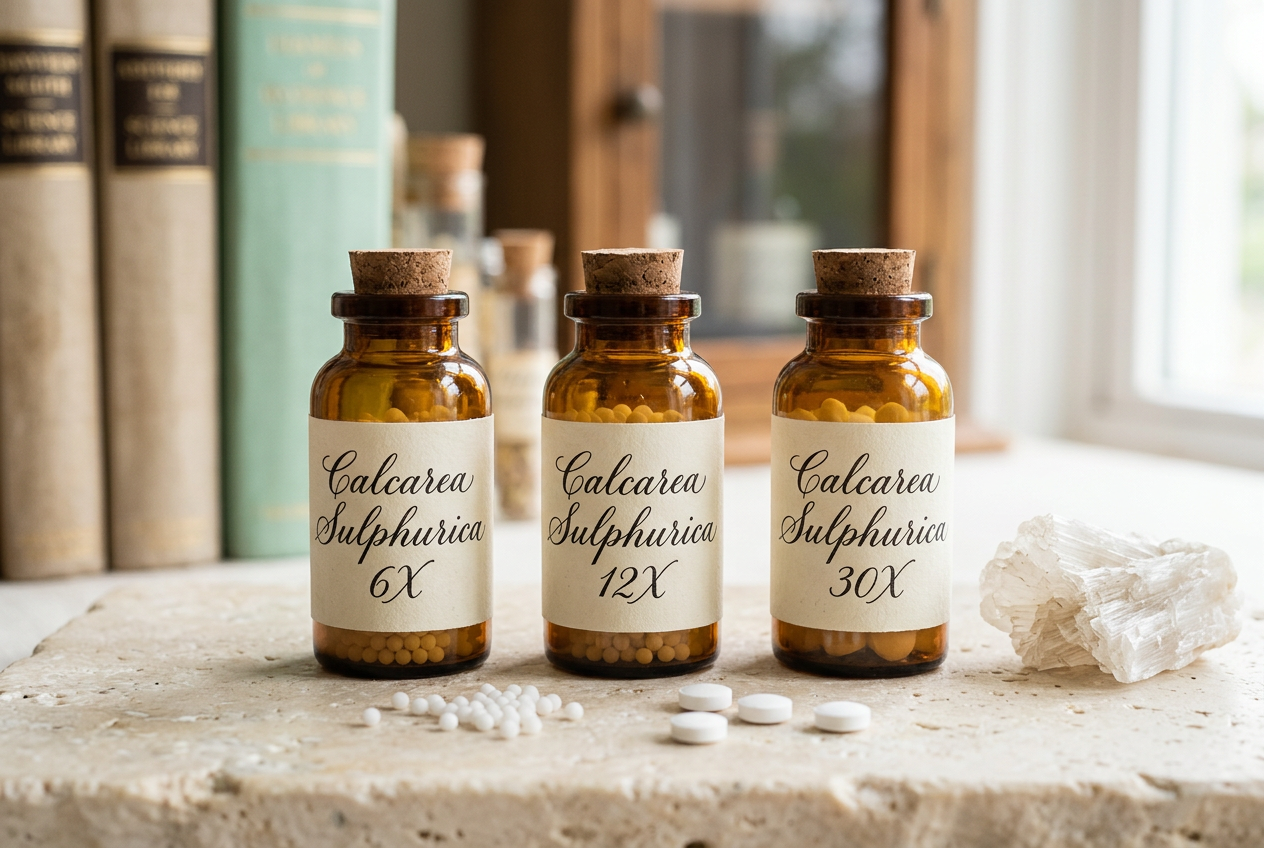
Calcarea Sulphurica is available in several potencies, each suited to a different phase of treatment:
- 6X (D6): The standard low potency for acute suppurative conditions and short-term use. Suitable for the resolution phase of boils, tonsillitis, catarrh, and minor wounds. Dose: 1 tablet sublingual, 3–4 times daily, 15 minutes away from food. In acute episodes, every 2–3 hours for up to 48 hours.
- 12X (D12): A medium potency for subacute or recurrent conditions, or when the 6X has been used for the initial acute phase and a lower frequency is desired. Dose: 1 tablet sublingual, 2–3 times daily.
- 30X (D30): A higher potency for deep-seated, chronic suppurative tendencies, or as a constitutional dose taken once daily or every other day.
All potencies are taken sublingually — dissolved under the tongue away from food and drink (15 minutes before or after). The tablets may be crushed for children or those with sensitive mouths. Calcarea Sulphurica is often alternated with Silicea: Silicea to ripen the suppurative process, Calcarea Sulphurica to close it.
Final Thoughts
Calcarea Sulphurica occupies a small but distinct place in the biochemic system. It is not a first-aid remedy for acute inflammation — that is the territory of Ferrum Phosphoricum. It is not a salt for the exudative phase — that is Kalium Muriaticum. It is not a salt for bringing a boil to a head — that is Silicea. Calcarea Sulphurica is the salt that closes the door after the storm has passed.
In an era of routine antibiotics and elective surgeries, the gentle art of supporting the body’s own resolution phase is too often overlooked. When a child’s tonsils are removed because the pattern of recurrence has not been addressed at the tissue level, or when antibiotics are prescribed for the sixteenth time for a sore throat that would resolve on its own, something important has been lost — the recognition that the body knows how to close a process, if it is given the materials it needs.
Calcarea Sulphurica is one of those materials. In the everyday landscape of stubborn boils, lingering catarrh, wounds that will not quite close, and throats that discharge thick yellow matter — it is a quiet, effective, and deeply rational support.
Silicea ripens. Calcarea Sulphurica heals. The sequence works.
Dr. Hermes Trismegistus, M.D.
Doctorate in Schüssler Biochemic Medicine · Chief Medical Scholar, ABUGALY Holistic-Medical Institute
Books for Further Study
- Carey GW. The Biochemic System of Medicine (1894) — Buy on Amazon
- Schüssler WH. An Abridged Therapy: The Biochemical Treatment of Disease — Buy on Amazon
- Boericke W, Dewey WA. The Twelve Tissue Remedies of Schüssler — Buy on Amazon
- Chapman & Perry. The Biochemic Handbook — Buy on Amazon
- Carey GW. The Chemistry of Human Life — Buy on Amazon
- Strbac L. Schuessler’s Tissue Salts Rediscovered — Buy on Amazon
Available Preparations: 6X, 12X and 30X
Note on numbering: cell-salt numbering systems differ between manufacturers — Hyland’s, for example, numbers the salts in a different order from the classical Schüssler sequence. Always identify a preparation by its Latin name (e.g. Calcarea Sulphurica, Silicea), never by the number on the label alone.