WELLNESS & HEALTH · DR. HERMES, M.D.
Calcarea Fluorica — Elasticity, Structure and the Therapeutic Dead-End
A source-led Wellness & Health examination of Calcarea Fluorica in the Schüssler-Carey tradition: its historical materia medica, the clinical dead-end cases, and the 6X, 12X and 30X preparations.
What Is Calcarea Fluorica?
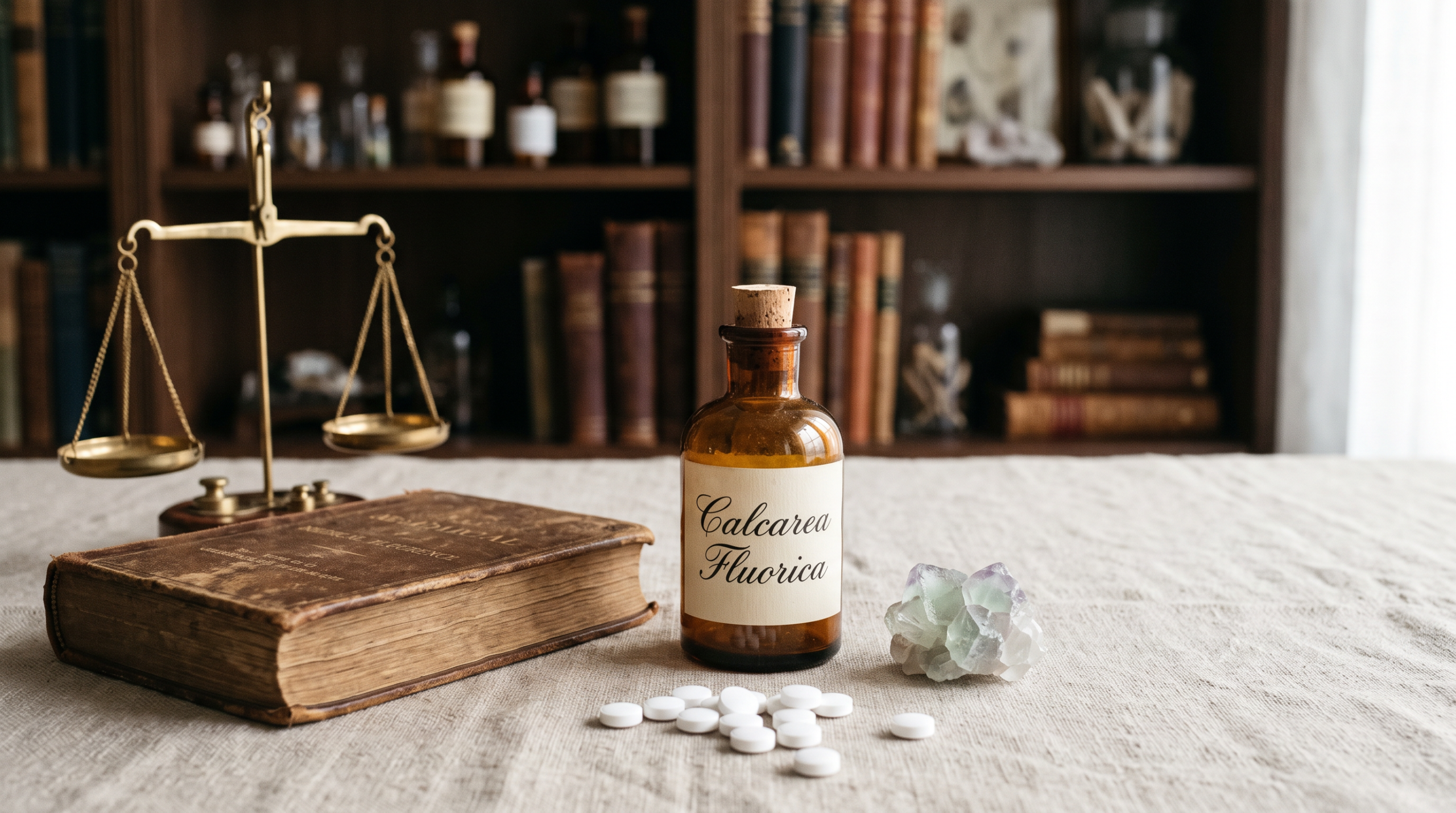
Calcarea Fluorica — also written Calc. fluor. or calcium fluoride — is one of the twelve inorganic cell salts that form the foundation of Dr. Wilhelm Schüssler’s Biochemic system of medicine. It is a mineral salt of lime (calcium) combined with fluorine, and it is found in the human body primarily in the enamel of teeth, the surface layer of bones, the connective tissue, and — most importantly — the elastic fibres of all muscular and vascular tissue.
In the 1894 text The Biochemic System of Medicine, Dr. George W. Carey, M.D., wrote that the fluoride of lime molecules “unite with albumen and form, i.e., create, elastic fibre.” This was his central mechanistic claim: that without sufficient Calc. fluor., the body cannot manufacture the elastic fibres that hold organs, blood vessels, and muscles in their proper position and tension.
Modern biochemistry acknowledges that fluoride is present in trace amounts in bone and tooth enamel, and calcium is essential for muscle contraction, vascular tone, and connective tissue integrity. While the specific Schüssler model of “elastic fibre creation by Calc. fluor. + albumen” is not supported by modern molecular biology, the clinical observation that calcium fluoride supports tissue firmness and elasticity has a long empirical tradition.
Discovery in Human Ashes
Like all twelve tissue salts, Calc. fluor. was identified through the analysis of the inorganic residue — the ash — left after the complete combustion of human tissue. In the 19th century, chemists such as Moleschott and Liebig analyzed these ashes and found trace amounts of calcium fluoride. Schüssler, building on the work of Virchow’s cellular pathology, reasoned that since a substance is present in healthy tissue, its deficiency must produce disease, and its restoration must restore health.
Carey’s 1894 text notes that the proportion of fluorine in the human organism is “still less than that of iron,” and estimates that a single milligram of Calc. fluor. per therapeutic dose is quite large by biochemical standards. This illustrates the infinitesimal quantities in which these salts operate — consistent with the broader principle of molecular medicine.

Historical Doctrine vs. Modern Evidence
What Schüssler and Carey Taught (Historical Doctrine)
Dr. Schüssler and Dr. Carey assigned to Calc. fluor. a very specific role: it is the elastic fibre remedy. In their model, a deficiency of this salt leads to a “relaxed condition” of the elastic fibres throughout the body, manifesting as:
- Prolapse and displacement: Falling of the womb (uterine prolapse), anteversion, retroversion, and flexions of the uterus. Carey described “dragging pains in the groin and in the lower part of the back” extending to the thighs.
- Vascular relaxation: Varicose veins, dilated blood vessels, hemorrhoids, and a tendency for veins to feel “as if they would burst.”
- Hard swellings: Stony-hard lumps in the breast, osseous growths on bones, indurated glands, and encysted tumors. Carey wrote that the “substance that causes the hard accumulation is elastic fibre or lime.”
- Dental issues: Loose teeth in their sockets, rough or thin enamel, rapid decay where enamel is deficient, brittle teeth.
- Connective tissue laxity: A general “sagging-down feeling,” relaxed blood vessels, elongated uvula, and fissures of the anus or lips.
- Mental symptoms: Carey described “groundless fears of financial ruin” arising from a deficiency of Calc. fluor. in the connective tissue between the cerebrum and cerebellum, causing an “abnormal process of thought.”
Carey also reported clinical success with high potencies (from the 6x up) in cases of hard breast lumps, and he urged practitioners to use hot applications for relief, especially in hardened conditions, though cold could help when contraction was needed.
What Modern Science Says (Evidence-Based View)
Modern biochemistry and medicine do not recognize the Schüssler model of “elastic fibre creation by calcium fluoride” as a literal molecular mechanism. Elastic fibres are composed of elastin and fibrillin, synthesized by fibroblasts through entirely different biochemical pathways involving tropoelastin, cross-linking by lysyl oxidase, and copper-dependent reactions. Calcium fluoride does not directly participate in this synthesis.
However, several of the clinical observations associated with Calc. fluor. do map to known physiological processes:
- Calcium and vascular tone: Calcium ions are essential for smooth muscle contraction in blood vessel walls. A deficiency in bioavailable calcium can contribute to venous insufficiency, hemorrhoids, and poor vascular tone — conditions that overlap with the historical “relaxed elastic fibre” picture.
- Fluoride and bone density: Fluoride stimulates osteoblast activity and has been used therapeutically (though controversially) to increase bone density. The trace amounts in the Schüssler preparation are far below pharmacological levels, but the association with bone and tooth health has a plausible basis.
- Connective tissue integrity: Calcium is a cofactor for enzymes involved in collagen cross-linking and tissue repair. Adequate calcium status supports wound healing, ligament strength, and mucosal integrity.
- Hemorrhoids and venous disease: Modern treatment for hemorrhoids and varicose veins includes bioflavonoids, fibre, and vein-tonic agents. The Calc. fluor. picture — bleeding, protruding piles with bearing-down pain — corresponds to a subset of patients who may benefit from mineral support for vascular wall integrity.
Controlled clinical trials on Calc. fluor. as a single remedy are virtually nonexistent. The evidence base is largely empirical, drawn from 150 years of clinical observation in the homoeopathic and biochemical traditions.
Biochemic Pathology: How Carey Explained Disease
In the Biochemic system, disease is not an entity but a condition — a “lack of some constituent part of the blood at the part affected,” as Virchow defined it. When the chain of Calc. fluor. molecules is broken, the body cannot produce elastic fibre in sufficient quantity, and the tissues that depend on that fibre — blood vessels, uterus, ligaments, skin — begin to sag, stretch, or fail.
Carey described the process this way: “A deficiency of elastic fibre in muscular tissue causes falling of the womb, varicose veins and a general ‘sagging-down feeling.’” The body calls for the missing salt through symptoms — pain, discomfort, or dysfunction — and the physician’s task is to read those signals and supply the deficiency in molecular form.
This was a radical departure from the allopathic medicine of the 1890s, which relied on purging, bleeding, and toxic drugs. Carey argued that “to give poisons to a sick person is simply barbarous and inhuman,” and that the only rational cure is to supply what the blood lacks.
What Calc. fluor. Treats (The Indications)
Based on the historical literature and clinical tradition, Calc. fluor. is indicated for conditions involving relaxed or overstretched tissues, hardened swellings, and calcium-fluoride deficiency in the structura:
Circulatory System
- Varicose veins and varicose ulcers
- Hemorrhoids — bleeding, protruding, or blind, with pain in the back and constipation
- Dilated blood vessels, first stage of aneurysm (alternating with Ferrum phos.)
- Poor circulation with a tendency to easy bruising
Female Reproductive System
- Uterine prolapse, anteversion, retroversion, flexions
- Dragging pains in the groin and lower back, extending to the thighs
- Excessive menstruation with bearing-down pains
- Hard, stone-like uterus or, conversely, a very relaxed and flabby uterus
- After-pains that are too weak; hemorrhage when the uterus does not contract
- Hard knots and kernels in the breast
Musculoskeletal System
- Hard growths or excrescences on bone surfaces
- Gouty enlargement of the joints
- Hard swellings of stony hardness
- Bruises on the bones that leave hard, uneven lumps
- Suppurations of the bones and periosteum
Dental and Oral
- Loose teeth in their sockets
- Rough, thin, or brittle enamel; rapid decay
- Cracked lips or chapped hands from cold (alternating with Ferrum phos.)
Skin and Connective Tissue
- Chapped hands or lips
- Hard, horny skin; cracks in the palms of the hands
- Fissure of the anus; fistulous ulcers with thick, yellow pus
- Encysted tumors and indurated enlargements
General Symptoms
- A “sagging-down” feeling throughout the body
- Relaxed conditions of the muscles and blood vessels
- Groundless fears, especially of financial ruin
- Worse from cold; better from hot applications

DEAD-END Cases: Where a Specific Intervention Plateaued
It means that a specific intervention has reached an evidence-based limit: it may offer little meaningful benefit, create an unfavourable trade-off, or be proposed before a better-supported conservative route. The following three cases come from the ABUGALY Holistic-Medical Institute.
1. Knee osteoarthritis: repeated viscosupplementation
The research group reviewed two major systematic reviews of intra-articular hyaluronic-acid injections. Rutjes et al. analysed 89 trials (12,667 adults); in the 18 large blinded trials, the pain effect was clinically irrelevant and serious adverse events were more frequent (RR 1.41, 95% CI 1.02–1.97). Pereira et al. analysed 169 trials (21,163 participants) and found an effect of about 2 mm on a 100-mm pain scale in large placebo-controlled trials—below the predefined clinically important difference—with serious adverse events increased (RR 1.49, 95% CI 1.12–1.98).
What Dr. Hermes would propose: do not market a repeated injection cycle as cartilage rebuilding. Discuss the evidence with the treating clinician, then make progressive strength, aerobic and balance work, weight management where relevant, and a measurable function plan the centre of care.
Dr. Hermes protocol — knee osteoarthritis
- Calcarea Fluorica D12: 1 tablet sublingually twice daily for 12 weeks.
- Calcarea Phosphorica D6: 1 tablet sublingually three times daily for 12 weeks.
- Natrium Sulphuricum D6: 1 tablet sublingually twice daily for 8–12 weeks, where swelling or effusion forms part of the picture.
- Ferrum Phosphoricum D12: 1 tablet sublingually twice daily for 8 weeks; during a short inflammatory flare, three times daily for 3–5 days.
- How to take: allow each tablet to dissolve under the tongue, 15 minutes away from food, coffee, or strong flavours. Track pain, walking tolerance, swelling, weight and exercise adherence at weeks 4, 8 and 12.
2. Chronic tennis elbow: the corticosteroid shortcut
In the placebo-controlled Coombes trial (165 patients with lateral epicondylalgia), corticosteroid injection produced worse one-year recovery or major improvement than placebo injection (83% versus 96%) and a higher recurrence rate (54% versus 12%). The finding concerns chronic lateral epicondylalgia and does not apply automatically to every painful elbow or every clinical indication for corticosteroids.
What Dr. Hermes would propose: first clarify the diagnosis and exclude nerve or cervical involvement where indicated; then use load modification and a progressive tendon-rehabilitation programme as the measurable intervention.
Dr. Hermes protocol — chronic tennis elbow
- Silicea D12: 1 tablet sublingually each morning for 12 weeks.
- Calcarea Fluorica D12: 1 tablet sublingually twice daily for 12 weeks.
- Magnesia Phosphorica D6: 1 tablet sublingually twice daily; for a pain flare, dissolve 1 tablet in warm water every 10–15 minutes, up to 6 doses in one day.
- Ferrum Phosphoricum D12: 1 tablet sublingually twice daily during an inflammatory flare, for 1–2 weeks.
- How to take: allow the tablets to dissolve under the tongue, 15 minutes away from food, coffee, or strong flavours. Review pain, grip tolerance and exercise progression at weeks 4, 8 and 12.
3. Pelvic organ prolapse: transvaginal mesh
A 2018 Cochrane review of 19 trials (2,717 women) found that anterior mesh could increase de-novo stress urinary incontinence while adverse events were incompletely reported. On April 16, 2019, the FDA ordered manufacturers to stop selling transvaginal mesh for pelvic organ prolapse after safety and effectiveness had not been adequately demonstrated. This is a precise history of one device route; it is not a statement that all prolapse surgery is inappropriate.
What Dr. Hermes would propose: a pelvic-floor assessment, pelvic-floor muscle training, treatment of constipation and relevant load factors, and discussion of a pessary before invasive escalation where clinically appropriate.
Dr. Hermes protocol — pelvic organ prolapse
- Calcarea Fluorica D12: 1 tablet sublingually twice daily for 12 weeks.
- Silicea D12: 1 tablet sublingually each morning for 12 weeks.
- Calcarea Phosphorica D6: 1 tablet sublingually twice daily for 8–12 weeks.
- Magnesia Phosphorica D6: 1 tablet sublingually twice daily; during a pelvic-pain flare, dissolve 1 tablet in warm water every 10–15 minutes, up to 6 doses in one day.
- How to take: allow the tablets to dissolve under the tongue, 15 minutes away from food, coffee, or strong flavours. Review pelvic-floor symptoms, bowel function and response to pelvic-floor training at 3, 6 and 12 months.
How the historical Calc. fluor. picture fits: Carey’s own report
Carey’s Calcarea Fluorica chapter is the source of the phrase that has made this remedy famous. After setting out his theory that fluoride of lime, albumen and oxygen were the chief factors in elastic-fibre formation, he wrote: “The wonders I have wrought with this tissue cell-salt in cases of hard lumps in the female breast, or in swellings of stony hardness, and other cases where a deficiency is indicated, would not be believed by many practitioners without personal observation or more proof than a mere statement by a Biochemic enthusiast.”
His clinical picture was broad. He grouped with Calc. fluor. hard or “stony” swellings; hardened glands and encysted tumours; hard knots and kernels in the breast; relaxed or flabby uterine tissue; varicose veins; hard growths on bone; uneven hard lumps remaining after bony bruises; fissures; loose teeth and deficient enamel; and tissues he described as relaxed or deprived of elastic fibre.
What Carey actually reported as protocol
- Potency: Carey’s only general potency statement immediately after the breast-lump passage is: “I have had the best results with high potencies, from the sixth up.” In the terminology of the book, this means the sixth decimal trituration and higher preparations; it is the source-based limit of what he specifies there.
- Local measures: for varicose veins he wrote “use also a lotion of the drug”; for bleeding or protruding piles he referred to external application; and for anal fissure he wrote that the remedy “should also be used locally.”
- Heat and cold: Carey’s stated modality was that hot applications would generally relieve, “especially in hardened conditions”; cold was sometimes beneficial when contraction was required.
- Related remedies: he noted alternatives or companions in selected patterns—Kalium muriaticum for hard breast knots and kernels, Ferrum phosphoricum for a first-stage aneurism pattern, and Calcarea phosphorica in some relaxed or structural patterns.
Clinical References for the Three DEAD-END Cases
- Rutjes AW, Jüni P, da Costa BR, Trelle S, Nüesch E, Reichenbach S. Viscosupplementation for osteoarthritis of the knee: a systematic review and meta-analysis. Annals of Internal Medicine. 2012;157(3):180–191. PMID: 22868835.
- Pereira TV, Jüni P, Saadat P, et al. Viscosupplementation for knee osteoarthritis: systematic review and meta-analysis. BMJ. 2022;378:e069722. PMID: 36333100.
- Coombes BK, Bisset L, Brooks P, Khan A, Vicenzino B. Effect of corticosteroid injection, physiotherapy, or both on clinical outcomes in patients with unilateral lateral epicondylalgia: a randomized controlled trial. JAMA. 2013;309(5):461–469. PMID: 23385272.
- Baessler K, Christmann-Schmid C, Maher C, Haya N, Crawford TJ, Brown J. Surgery for women with pelvic organ prolapse with or without stress urinary incontinence. Cochrane Database of Systematic Reviews. 2018;8:CD013108. PMID: 30121956.
- U.S. Food and Drug Administration. FDA orders manufacturers of surgical mesh intended for transvaginal repair of pelvic organ prolapse to stop selling all devices. April 16, 2019.
Dosage and Potency
In the Biochemic tradition, Calc. fluor. is used in low potencies, typically the 3x to 12x decimal trituration or liquid dilution. The 6x is considered the standard general-use potency. Acute conditions may respond to more frequent dosing (every 15–30 minutes), while chronic conditions are managed with 3–4 doses per day.
Carey recommended high potencies — from the 6th up — for his most impressive results, and noted that hot applications generally relieve the conditions indicating this salt, while cold is sometimes beneficial when contraction is required.
As with all tissue salts, Calc. fluor. is best taken away from strong flavors (coffee, mint, camphor) and allowed to dissolve under the tongue for optimal absorption through the oral mucosa.
Final Thoughts
Calcarea Fluorica occupies a unique place in the tissue salt materia medica: it is the structural remedy, the elastic fibre support, the salt that addresses the “sag” in the body’s framework. While its historical mechanism — direct creation of elastic fibre — does not align with modern molecular biology, its clinical picture of relaxed tissues, hard swellings, and vascular weakness remains a coherent and useful therapeutic guide after 150 years of use.
The Biochemic system reminds us that the body’s structure is built from the minerals we consume, and that restoring those minerals in bioavailable form can support the body’s own healing processes. Calc. fluor. is, in this sense, a tissue food — not a drug, but a building block that the body knows how to use.
In the words of Dr. Carey: “The wonders I have wrought with this tissue cell-salt in cases of hard lumps in the female breast, or in swellings of stony hardness, and other cases where a deficiency is indicated, would not be believed by many practitioners without personal observation.”
Dr. Hermes Trismagestus, M.D.
Doctorate in Schüssler Biochemic Medicine · Chief Medical Scholar, ABUGALY Holistic-Medical Institute

Books for Further Study
- George W. Carey, M.D. The Biochemic System of Medicine (1894) — the foundational English-language Schüssler-Carey text. Buy on Amazon →
- Wilhelm Heinrich Schüssler, M.D. An Abridged Therapy: Manual for the Biochemical Treatment of Disease — the original system in its 25th-edition English translation. Buy on Amazon →
- William Boericke & Willis A. Dewey. The Twelve Tissue Remedies of Schuessler — a classic materia-medica reference. Buy on Amazon →
- J. B. Chapman & Edward L. Perry. The Biochemic Handbook: How to Get Well and Keep Fit With Biochemic Tissue Salts — a later practical handbook. Buy on Amazon →
- Lisa Strbac. Schuessler’s Tissue Salts Rediscovered: The 21st Century Guide to Self-Healing — a contemporary reader’s guide. Buy on Amazon →
Available Preparations: 6X, 12X and 30X
Note on numbering: cell-salt numbering systems differ between manufacturers — Hyland’s, for example, numbers the salts in a different order from the classical Schüssler sequence. Always identify a preparation by its Latin name (e.g. Calcarea Sulphurica, Silicea), never by the number on the label alone.
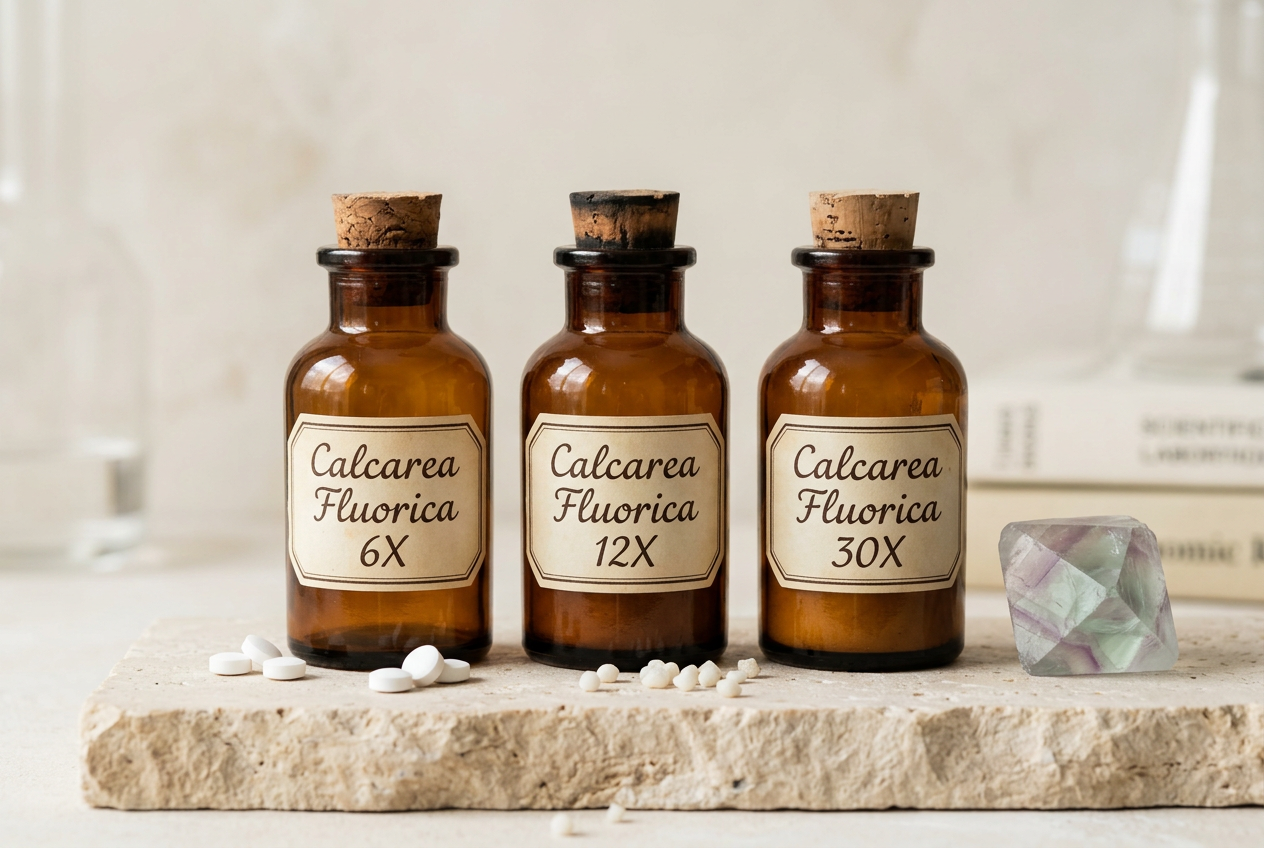
Calcarea Fluorica is available in several decimal potencies. The selection below offers four 6X preparations, four 12X preparations, and two 30X preparations.