WELLNESS & HEALTH · DR. HERMES, M.D.
Ferrum Phosphoricum — The First-Aid Salt of Inflammation and Fever
A source-led Wellness & Health examination of Ferrum Phosphoricum in the Schüssler-Carey tradition: its historical materia medica, the cases where conventional care plateaus, and the 6X, 12X and 30X preparations.
What Is Ferrum Phosphoricum?
Ferrum Phosphoricum — also written Ferr. phos. or iron phosphate — is the third of the twelve inorganic cell salts that form the foundation of Dr. Wilhelm Schüssler’s Biochemic system of medicine. It is the salt of iron combined with phosphate, and it occupies a unique position in the materia medica as the first remedy for inflammation — the tissue salt that addresses the initial, congestive stage of any acute condition.
In the 1894 text The Biochemic System of Medicine, Dr. George W. Carey, M.D., wrote: “Iron phosphate colors the blood corpuscles red, carries oxygen to all parts of the body, and thus furnishes the vital force that sustains life. Without a proper balance of iron in the blood, health cannot be maintained.” This was his central mechanistic claim: that iron phosphate is the oxygen carrier and the very source of the body’s vital force.
Modern biochemistry confirms that iron is an essential component of hemoglobin, the protein in red blood cells that binds and transports oxygen. Iron is also a cofactor for cytochrome enzymes in the mitochondrial electron transport chain, making it indispensable for cellular respiration and energy production. Phosphate, in turn, is central to ATP energy metabolism. The Schüssler model — that iron phosphate is the oxygen carrier and vital force of the blood — is broadly consistent with the modern understanding, though the specific mechanism of action attributed to the triturated preparation differs.
Discovery in Human Ashes
Iron is present in human blood in trace but essential amounts. The analysis of blood ash in the 19th century revealed the presence of iron phosphate, and Schüssler calculated that a quart of milk contains approximately the six-millionth of a grain of iron — a figure he used to illustrate the infinitesimal quantities in which these salts operate.
Carey wrote: “Four milligrammes represent the whole quantity of iron in the milk supplied per day for a child’s nourishment and growth, and this is sufficient to feed all the cells that are known to contain iron, and consequently require iron.” This observation — that the body needs only vanishingly small amounts of iron, yet those amounts are absolutely critical — remains a cornerstone of modern hematology, where iron deficiency anemia is the most common nutritional deficiency worldwide.

Historical Doctrine: What Schüssler and Carey Taught
Ferrum Phosphoricum was, in the 19th-century Biochemic system, the single most important acute remedy — the “fire extinguisher” for inflammation. Dr. Schüssler and Dr. Carey assigned to it a very specific role: it is the oxygen carrier and the first remedy for all inflammations. In their model, a deficiency of this salt leads to increased circulation, fever, and a breakdown of vascular integrity.
Carey’s explanation of fever is one of the most original contributions of the Biochemic system. He wrote:
“When a deficiency in this cell-salt occurs, the circulation is increased, for the blood tries to carry enough oxygen to all the tissues of the body with the limited amount of iron at hand, and in order to do so must move rapidly; exactly as seven men must move faster in order to accomplish as much work as ten men moving at a slower pace. This increased motion being changed to heat, by the law of the conservation of energy, is called fever.”
He further argued that the rapid circulation serves three purposes: to throw off waste organic matter (heteroplasm), to try to furnish material to all parts of the system to sustain life, and to carry sufficient oxygen with the limited iron molecules available.
Carey also described the mechanism of colds and catarrh in iron deficiency: “A lack of ferrum molecules, viz.: a proper balance in the blood, is the cause of ‘colds.’” He argued that iron deficiency causes the blood to withdraw from the skin, closing the pores and turning waste matter onto the inner organs, producing the exudations of colds, catarrh, pneumonia, and pleurisy.
On the role of Ferr. phos. in inflammation, Carey wrote: “For all such conditions, whenever there is inflammation, under whatever name it may be known, Ferr. phos. is the chief remedy. While those who adhere to the old way are trying, by ‘careful diagnosis,’ to find out if the patient has typhus, or typhoid, or malarial, or bilious fever, the Biochemist is giving Ferr. phos., because he sees in the symptoms a call for that tissue-salt. The name of the ailment is of no consequence.”
Regarding hemorrhage, he stated: “Ferrum molecules toughen the cellular structure in the circular walls of the blood-vessels, hence a lack of iron frequently causes a breaking-down of the walls of minute blood-vessels, producing hemorrhage. Ferr. phos. is indicated in hemorrhage from any orifice of the body.”
Carey’s most dramatic claim was that the Biochemist gives Ferr. phos. because he sees in the symptoms a call for that tissue-salt — that the name of the disease is of no consequence; what matters is the underlying deficiency.
What Ferr. phos. Treats (The Indications)
Based on the historical literature and clinical tradition, Ferr. phos. is indicated for conditions involving the first stage of inflammation, fever, congestion, and bright-red hemorrhage:
Inflammatory Conditions (First Stage)
- Pneumonia, bronchitis, pleurisy — first stage, with fever, pain, and congestion
- Tonsillitis, pharyngitis, laryngitis — red, inflamed, painful throat
- Otitis media — earache with beating, throbbing pain
- Conjunctivitis — acute inflammation of the eye with intolerance of light
- Cystitis — first stage of bladder inflammation with pain and retention
- Gastritis — burning pain in the stomach, tender to touch, pain after the smallest amount of food
- Rheumatic fever — with inflammation, heat, and swelling
Fever
- First stage of all febrile conditions — enteric, gastric, typhoid, typhus, scarlet fever, measles, chicken-pox, small-pox
- Catarrhal fever with quickened pulse and chilly sensations
- Intermittent fever with vomiting of food
- Full, rapid, quick pulse in fevers
Hemorrhage
- Nosebleed — bright red blood, from injury or spontaneous
- Hemorrhage from the lungs — bright red blood
- Vomiting of bright red blood
- Bleeding hemorrhoids — bright red blood, very sore and painful
- Hemorrhage from any orifice of the body when the blood is bright red and tends to coagulate quickly
Respiratory System
- Hard, dry, painful cough — first stage of any respiratory infection
- Croup and whooping-cough — for the febrile condition
- Short, hurried breathing at the onset of disease
- Painful hoarseness of speakers and singers from irritation
- Congestion of the lungs with oppression and pain
Musculoskeletal
- Inflammatory pains in the back and loins (lumbago)
- Strains and sprains — first stage
- Rheumatic pains aggravated by motion
- Stiff neck from cold
- First remedy in gatherings and festers, to relieve heat, pain, and congestion
General Symptoms
- Flushed face with headache
- Clean, red tongue — indicating an inflammatory condition
- Thirst for cold drinks
- All symptoms relieved by cold applications
- All symptoms aggravated by motion
- Nosebleed relieves the headache
Where Conventional Care Plateaus: When a Specific Intervention Reaches Its Limit
It means that a specific intervention has reached an evidence-based limit: it may offer little meaningful benefit, create an unfavourable trade-off, or be proposed before a better-supported conservative route. The following two cases come from the ABUGALY Holistic-Medical Institute.
The single salt, and when a combination is warranted
The protocols in this article prescribe one tissue salt — Ferrum Phosphoricum, the salt of this article — rather than a mixture. This is a deliberate choice of method, not an omission. The biochemic system is mineral-specific: each tissue salt corrects one discrete biochemical function, and one salt, correctly chosen and given time, removes the deficiency that holds the clinical picture in place. A single prescription is also traceable: when the patient improves, we know precisely which salt carried the signal. When several salts are given together, the signal is scattered, and neither the clinician nor the patient can tell which remedy was decisive.
For the great majority of plateau cases — where one dominant deficiency underlies the picture — the single salt is therefore the correct first prescription: D12 for the chronic state, D6 for the acute overlay, D30 for the stalled or long-suppressed case, reviewed at weeks 4, 8 and 12.
There is an honest exception, and the tradition itself recognises it. When a case presents with two or more distinct deficiencies at once — for example structural weakness together with nerve pain and acute inflammation — a multi-salt protocol is warranted. Schüssler himself combined the cell salts when the clinical picture demanded it. The single-salt prescription is therefore not a rule against combination; it is the discipline of starting with the dominant deficiency, observing the response, and adding a second salt only when the picture clearly requires it.
1. Knee osteoarthritis: repeated intra-articular corticosteroid injections
The research group reviewed the landmark randomised, placebo-controlled trial by McAlindon et al. (JAMA 2017, 140 patients, triamcinolone every 12 weeks vs saline for 2 years). This trial showed significantly greater cartilage volume loss in the corticosteroid group (mean −0.21 mm vs −0.10 mm over 2 years) with no difference in pain versus placebo. The patient in question — a 63-year-old retired builder with bilateral knee osteoarthritis (Kellgren-Lawrence grade II–III), type 2 diabetes, and a BMI of 30 — had received seven intra-articular triamcinolone injections over 18 months. Each injection gave 3–6 weeks of relief, after which the pain returned, while blood glucose spiked to 280 mg/dL for 3–5 days after each injection. The orthopaedist proposed continuing the injections and considering knee replacement when they failed. Repeated intra-articular corticosteroids therefore destroy cartilage without providing superior analgesia — an actively harmful, avoidable procedure.
What Dr. Hermes would propose: discontinue the repeated steroid injections (per the JAMA 2017 evidence of cartilage loss without pain benefit). The decisive disease-modifying interventions that must accompany the biochemic protocol are supervised exercise (quadriceps strengthening, low-impact aerobic), weight loss (target −5–10% body weight — proven symptomatic and structural benefit), physiotherapy, and walking aids if needed. The biochemic protocol supports the joint tissues during this transition.
Dr. Hermes protocol — knee osteoarthritis
- Ferrum Phosphoricum D12: 1 tablet sublingually three times daily for 12 weeks — the default plateau potency for chronic joint tissue states, supporting local oxygenation and regulating the inflammatory response.
- Ferrum Phosphoricum D6: 1 tablet sublingually three times daily for 5–7 days during acute pain flares with local heat — acute/functional overlay for the congestive-inflammatory flare.
- How to take: allow each tablet to dissolve under the tongue, 15 minutes away from food, coffee, or strong flavours. Track pain, walking tolerance, swelling, weight and exercise adherence at weeks 4, 8 and 12.
2. Acute bronchitis: the antibiotic reflex in viral respiratory infections
The research group reviewed the CDC 2023 Antibiotic Use surveillance data and the Cochrane Systematic Review on antibiotics for acute bronchitis (Cochrane Database Syst Rev 2017; CD000243). The Cochrane review analysed 17 randomised trials and found that antibiotics — whether amoxicillin, doxycycline, or macrolides — provided no significant benefit in reducing cough duration, purulent sputum, or time off work compared with placebo in patients with acute bronchitis. The CDC 2023 data confirm that approximately 90% of acute bronchitis cases are viral, yet antibiotic prescribing rates remain near 60% in primary care. The patient — a 38-year-old teacher, previously healthy, with acute rhinopharyngitis/bronchitis, productive cough, fever 38.2°C, 5 days duration, no pneumonia risk factors — was prescribed amoxicillin 1g ×5 days. Antibiotics are ineffective in viral bronchitis, cause gut dysbiosis, diarrhoea, rashes, and select for antimicrobial resistance — an unnecessary, avoidable intervention.
What Dr. Hermes would propose: Rest, hydration, and supportive care. Monitor fever and oxygen saturation; re-evaluate for bacterial pneumonia only if fever persists >7 days or SpO₂ <94%. The biochemic protocol supports the respiratory mucosa and the febrile response without the collateral damage of antibiotics.
Dr. Hermes protocol — acute bronchitis (viral)
- Ferrum Phosphoricum D6: 1 tablet sublingually every 4 hours during the acute febrile phase (first 3–5 days), then reduce to 3 times daily for a further 5 days — the classical first-stage salt for fever, congestion, and inflammation of the respiratory mucosa.
- Ferrum Phosphoricum D12: 1 tablet sublingually twice daily for 10 days — supports tissue oxygenation and the resolution phase after the initial fever subsides.
- How to take: allow each tablet to dissolve under the tongue, 15 minutes away from food, coffee, or strong flavours. Monitor temperature, cough frequency, and general well-being at days 3, 7, and 10. If fever persists beyond 7 days or breathing becomes difficult, seek conventional medical evaluation.
Clinical References for the Two Cases
- McAlindon TE, et al. Effect of Intra-articular Triamcinolone vs Saline on Knee Cartilage Volume and Pain in Patients With Knee Osteoarthritis: A Randomized Clinical Trial. JAMA. 2017;317(19):1967-1975. PMID: 28510679.
- CDC. Antibiotic Use in the United States, 2023: Progress and Opportunities. Centers for Disease Control and Prevention, 2023.
- Smith SM, Fahey T, Smucny J, Becker LA. Antibiotics for acute bronchitis. Cochrane Database Syst Rev. 2017;(6):CD000243. PMID: 28497499.
- Rutjes AW, Jüni P, da Costa BR, Trelle S, Nüesch E, Reichenbach S. Viscosupplementation for osteoarthritis of the knee: a systematic review and meta-analysis. Annals of Internal Medicine. 2012;157(3):180-191. PMID: 22868835.
- Pereira TV, Jüni P, Saadat P, et al. Viscosupplementation for knee osteoarthritis: systematic review and meta-analysis. BMJ. 2022;378:e069722. PMID: 36333100.
- U.S. Food and Drug Administration. FDA orders manufacturers of surgical mesh intended for transvaginal repair of pelvic organ prolapse to stop selling all devices. April 16, 2019.
Dosage and Potency
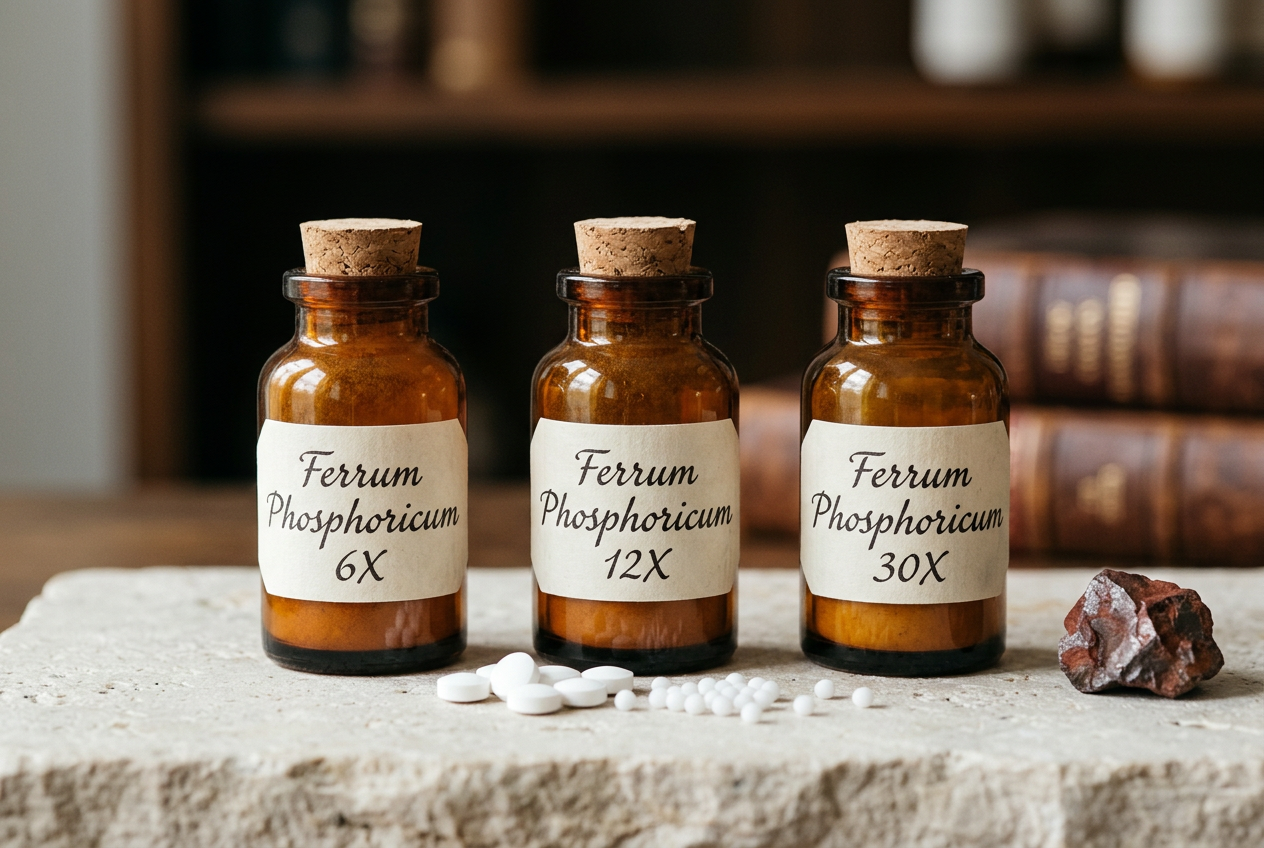
In the Biochemic tradition, Ferr. phos. is used in low potencies, typically the 3x to 12x decimal trituration or liquid dilution. The 6x is considered the standard general-use potency. In acute conditions, it is given every 15–30 minutes until symptoms begin to resolve, then reduced to 3–4 times daily. In chronic conditions, the 12x or 30x potency may be used 2–3 times daily.
Carey recommended the 3x potency for acute cases and the 6x, 30x, and 200x for chronic cases. He noted that “high potency of an inorganic mineral salt does not lose its entity or change to ‘the spirit of the drug,’ but is always the same substance, however fine it may be pulverized.”
Cold applications, used externally over the affected area, support the action of Ferr. phos. since most of its symptoms are congestive and relieved by cold. As with all tissue salts, Ferr. phos. is best taken away from strong flavours (coffee, mint, camphor) and allowed to dissolve under the tongue for optimal absorption through the oral mucosa.
Final Thoughts
Ferrum Phosphoricum is the first responder of the tissue salt system — the remedy that meets the body’s most urgent call for support in the inflammatory stage of illness. Its historical role as the “oxygen carrier” and “inflammation remedy” has a plausible basis in iron’s essential function in hemoglobin and cellular respiration, even if the specific mechanisms proposed by Schüssler and Carey are not supported by modern physiology.
What the Biochemic tradition gets right about Ferr. phos. is the recognition that inflammation is not the enemy — it is the body’s attempt to heal. The role of the physician is not to suppress this process but to support it by supplying the materials the body needs to carry it through. In this sense, Ferr. phos. is not an anti-inflammatory drug in the conventional sense; it is a tissue food that enables the body to regulate its own inflammatory response.
In the words of Dr. M. Docetti Walker, writing in the 1894 edition: “What remedy more glorious than Ferrum phos. in not only preventing such fevers, cutting them short, but when called into a case with all its dreaded sequelae threatening, we select our Ferrum as the chief remedial agent.”
Dr. Hermes Trismegistus, M.D.
Doctorate in Schüssler Biochemic Medicine · Chief Medical Scholar, ABUGALY Holistic-Medical Institute
Books for Further Study
- George W. Carey, M.D. The Biochemic System of Medicine (1894) — the foundational English-language Schüssler-Carey text. Buy on Amazon →
- Wilhelm Heinrich Schüssler, M.D. An Abridged Therapy: Manual for the Biochemical Treatment of Disease — the original system in its 25th-edition English translation. Buy on Amazon →
- William Boericke & Willis A. Dewey. The Twelve Tissue Remedies of Schuessler — a classic materia-medica reference. Buy on Amazon →
- J. B. Chapman & Edward L. Perry. The Biochemic Handbook: How to Get Well and Keep Fit With Biochemic Tissue Salts — a later practical handbook. Buy on Amazon →
- Lisa Strbac. Schuessler’s Tissue Salts Rediscovered: The 21st Century Guide to Self-Healing — a contemporary reader’s guide. Buy on Amazon →
- Dr. M. Docetti Walker, M.D. Abridged Therapeutics, Founded Upon Histology & Cellular Pathology — Schüssler’s authorised translation by Dr. Walker of Dundee, the source of the celebrated Ferrum phosphoricum passage. Buy on Amazon →
Available Preparations: 6X, 12X and 30X
Note on numbering: cell-salt numbering systems differ between manufacturers — Hyland’s, for example, numbers the salts in a different order from the classical Schüssler sequence. Always identify a preparation by its Latin name (e.g. Calcarea Sulphurica, Silicea), never by the number on the label alone.
Ferrum Phosphoricum is available in several decimal potencies. The selection below offers four 6X preparations, four 12X preparations, and two 30X preparations.