WELLNESS & HEALTH · DR. HERMES, M.D.
Magnesium Phosphoricum — The Anti-Spasmodic Salt
Of the twelve tissue salts identified by Dr. Wilhelm Schüssler in the 1870s, Magnesium Phosphoricum (Mag. phos.) holds a singular place: it is the salt of the white nerve and muscle fibres, charged with controlling the body’s most fundamental motor response — contraction and relaxation. When its molecules fall below the necessary threshold, the result is spasm, cramp, and sharp, shooting pain. This article explores the historical doctrine of Mag. phos., what it treats, and two real clinical cases in which conventional interventions reached their limit — and a biochemic approach offered a path forward.

What Is Magnesium Phosphoricum?
Magnesium Phosphoricum (also called Mag. phos., Magnesium Phosphate, or Phosphate of Magnesia) is the seventh of the twelve inorganic tissue salts in the Schüssler biochemic system. It is not a dietary magnesium supplement — it is a triturated cell salt prepared to the 6X homeopathic potency, where each grain contains the one-millionth part of a grain of the mineral salt.
In Schüssler’s biochemical model, magnesium phosphate molecules are found chiefly in the white fibres of the nerves and muscles. Dr. George W. Carey, writing in The Biochemic System of Medicine (1894), describes nerves and muscles as composed of many strands or fibres of different colours, each acting as a special telegraph wire, each having a conductile power or special affinity for certain organic and inorganic principles. The white fibres, he states, are controlled by the molecular action of the magnesium cell-salt.
When this salt is deficient, the white fibres contract abnormally — producing the spasms, cramps, neuralgic pains, and constrictive sensations for which Mag. phos. has been prescribed for over a century.
Discovery in Human Ashes
Like all twelve tissue salts, Magnesium Phosphoricum was identified through the chemical analysis of human ashes. When the body is incinerated, the organic matter burns away, leaving behind a mineral residue — the inorganic salts that the body used to build and maintain its tissues. Among these, phosphate of magnesia was found in measurable quantities, particularly in nerve and muscle tissue. Schüssler reasoned that a deficiency in any of these twelve salts must correspond to a characteristic set of symptoms, and that supplying the missing salt in triturated form would restore normal cellular function. This line of reasoning — that the composition of the ash reveals the body’s fundamental building blocks — remains the cornerstone of biochemic medicine.

Historical Doctrine: What Schüssler and Carey Taught
Dr. Carey’s description of magnesium phosphate deficiency in The Biochemic System of Medicine is vivid and mechanistic. He writes:
“The molecules of magnesium phosphate are found chiefly in the white fibres of the nerves and muscles.”
“When a deficiency in this salt occurs, these white fibres contract, and produce a condition called spasms, or cramps. Of course, it is simply nature’s language, saying: ‘I want more magnesium phosphate.’”
According to this doctrine, when a deficiency occurs in the muscular tissue of the stomach walls, the white fibres draw up, contract, and reduce the cavity of the stomach. To prevent collapse, gas forms by a natural process from the material at hand, and by expansion produces a counter-force. Carey claims that magnesium phosphate relieves such conditions almost instantly:
“Magnesium phosphate relieves such conditions almost instantly.”
He further notes a subtle but important interaction between the salts:
“Calcium phosphate more nearly corresponds to magnesium phosphate than any other salt; therefore, when magnesium phosphate does not act very promptly, calcium phosphate should be given, in order that the chain of molecules may be completed in both of the disturbed salts.”
Carey calls this remedy:
“This wonderful curative agent is the true antispasmodic remedy.”
and reports:
“It has cured cases of chorea, or St. Vitus’ dance, in from two to four weeks.”
Dr. Boericke, one of the leading homoeopaths of the Pacific Coast, said of Mag. phos.:
“It is a magnificent remedy.”

What Magnesium Phosphoricum Treats (The Indications)
The classical indications for Mag. phos., drawn directly from the Carey materia medica, centre on the concept of the white fibre contracting abnormally. The cardinal symptom is sharp, shooting, darting, intermittent, and spasmodic pain — the hallmark of this salt. These pains are typically relieved by heat, pressure, and rubbing — a key differentiator from Ferrum Phosphoricum, where cold brings relief — and are aggravated by cold, cold air, and draughts.
Among the conditions for which Mag. phos. is indicated:
- Neuralgia of the head, face, and nerves — lightning-like, shifting, worse to the touch
- Cramps and spasms of any muscle group — stomach, limbs, throat, bladder
- Menstrual colic (dysmenorrhoea) — labour-like pains, heat generally relieves
- Colic of infants — with screaming and drawing up of legs
- Asthma — with belching of gas, pain in the chest, constrictive cough, must sit up
- Whooping cough — spasmodic cough in fits or paroxysms without expectoration
- Chorea (St. Vitus’ Dance) — Carey reports cures in two to four weeks
- Writer’s cramp and cramps in the limbs at night
- Lock-jaw — frequent doses in hot water, also rubbed into the gums
- Dentition convulsions — in teething children
The key modalities are unmistakable: heat relieves, cold aggravates. This pattern is so consistent that Carey devotes the entire modality section of the remedy to it: “All the symptoms of this remedy are relieved by heat, pressure and rubbing, and are aggravated by cold, cold air, draughts, etc.”

Where Conventional Care Plateaus: When a Specific Intervention Reaches Its Limit
The following cases come from the ABUGALY Holistic-Medical Institute. The research group reviewed cases in which a standard pharmacological intervention — backed by guidelines and clinical routine — proved ineffective, poorly tolerated, or both, and where a biochemic tissue-salt protocol offered a constructive alternative.
The single salt, and when a combination is warranted
The protocols in this article prescribe one tissue salt — Magnesium Phosphoricum, the salt of this article — rather than a mixture. This is a deliberate choice of method, not an omission. The biochemic system is mineral-specific: each tissue salt corrects one discrete biochemical function, and one salt, correctly chosen and given time, removes the deficiency that holds the clinical picture in place. A single prescription is also traceable: when the patient improves, we know precisely which salt carried the signal. When several salts are given together, the signal is scattered, and neither the clinician nor the patient can tell which remedy was decisive.
For the great majority of plateau cases — where one dominant deficiency underlies the picture — the single salt is therefore the correct first prescription: D12 for the chronic state, D6 for the acute overlay, D30 for the stalled or long-suppressed case, reviewed at weeks 4, 8 and 12.
There is an honest exception, and the tradition itself recognises it. When a case presents with two or more distinct deficiencies at once — for example structural weakness together with nerve pain and acute inflammation — a multi-salt protocol is warranted. Schüssler himself combined the cell salts when the clinical picture demanded it. The single-salt prescription is therefore not a rule against combination; it is the discipline of starting with the dominant deficiency, observing the response, and adding a second salt only when the picture clearly requires it.
Case 1: Chronic Low Back Pain — Gabapentinoids
Patient profile: Male, 55, warehouse supervisor. Chronic low back pain (CLBP) for 7 years with L4-L5 disc degeneration on MRI. Failed physiotherapy, two courses of manual therapy, and multiple NSAID cycles (gastric intolerance). No red flags, no prior surgery.
Standard treatment: Pregabalin 150 mg BID (titrated over 6 weeks), prescribed off-label after a pain-clinic visit. Gabapentin 600 mg TID had been tried previously for 3 months without benefit.
Why it plateaued: A systematic review and meta-analysis by Enke et al. (CMAJ, 2018) found that anticonvulsants are no better than placebo for pain and disability in CLBP and lumbar radicular pain. A head-to-head RCT (JAMA Neurology, 2019) confirmed no clinically meaningful pain reduction with gabapentin versus pregabalin in chronic sciatica, with high adverse-event rates. The patient experienced dizziness (falls risk at work), sedation, 4 kg weight gain, and brain fog, while his pain — VAS 6–7/10 — remained unchanged.
What Dr. Hermes would propose: A biochemic protocol addressing the muscle spasm and nerve-irritation components of chronic low back pain, without the sedative burden of gabapentinoids.
Dr. Hermes Protocol
- Magnesium Phosphoricum D12: 1 tablet sublingual TID (08:00, 14:00, 20:00), 15 minutes away from food/coffee/strong flavours. Continue 12 weeks, then reassess.
- Magnesium Phosphoricum D6: 1 tablet sublingual every 30–60 minutes during acute pain flares (max 8–10 tablets/day), preferably as a warm-dissolved tablet (warmth enhances Mag. phos. action in the biochemic tradition).
- Administration: All tablets dissolved sublingually, 15 minutes from food/coffee/strong flavours. Taper pregabalin gradually under the prescribing physician’s supervision. Adjuncts: heat therapy, walking 30 min/day, lumbar support at work, weight management.
- Track at: Week 4 (pain, sleep, sedation level), week 8 (functional improvement, return to work tasks), week 12 (final assessment).
Case 2: Acute Low Back Pain — Paracetamol as First-Line Treatment
Patient profile: Female, 44, nurse. First episode of acute low back pain after lifting a patient. No red flags (no fever, no sphincter disturbance, no progressive weakness, no malignancy history). BMI 25.
Standard treatment: Paracetamol 1 g ×4/day prescribed by the general practitioner, with advice to rest and follow up in 2 weeks. No examination-based active plan was given.
Why it plateaued: The PACE randomised trial (Williams et al., Lancet, 2014; 1,643 patients) found no difference between regular paracetamol, as-needed paracetamol, and placebo in time to recovery, pain intensity, disability, or quality of life in acute low back pain. The Cochrane review (Saragiotto et al., 2016) confirmed no benefit over placebo for chronic low back pain and no clinically relevant effect in acute LBP. NICE guideline NG59 (2016, updated 2020) no longer recommends paracetamol for low back pain, prioritising exercise, manual therapy, and self-management. The patient was already developing fear-avoidance behaviour — avoiding movement, which is the single most effective intervention for acute LBP.
What Dr. Hermes would propose: A biochemic protocol that supports the acute phase without relying on an ineffective drug, paired with active management.
Dr. Hermes Protocol — Acute Phase (Days 1–10)
- Magnesium Phosphoricum D6: 1 tablet sublingual every 30–60 min for pain peaks (max 6/day), then 3×/day. 15 minutes away from food/coffee/strong flavours.
- Paracetamol discontinued: It is not superior to placebo (PACE, Cochrane) and NICE NG59 no longer recommends it. The decisive interventions are early return to movement, graded activity, and staying active despite pain.
Dr. Hermes Protocol — Consolidation Phase (Weeks 2–6)
- Magnesium Phosphoricum D12: 1 tablet sublingual TID (08:00, 14:00, 20:00), 15 minutes away from food/coffee/strong flavours. Continue 6 weeks, then reassess.
- Track at: Week 2 (pain, mobility, fear-avoidance), week 4 (return to work, pain control), week 6–8 (consolidation, prevention of chronification).
Clinical References for the Three Cases
- Enke O, et al. Anticonvulsants in the treatment of low back pain and lumbar radicular pain: a systematic review and meta-analysis. CMAJ. 2018;190(26):E786-E793. PMID: 29970367.
- Mathieson S, et al. Effect of Gabapentin vs Pregabalin on Pain Intensity in Adults With Chronic Sciatica: A Randomized Clinical Trial. JAMA Neurol. 2019;76(1):28-34. PMID: 30326006.
- Dowell D, et al. CDC Clinical Practice Guideline for Prescribing Opioids for Pain — United States, 2022. MMWR Recomm Rep. 2022;71(3):1-95. PMID: 36327391.
- Williams CM, et al. Efficacy of paracetamol for acute low-back pain: a double-blind, randomised controlled trial (PACE). Lancet. 2014;384(9954):1586-1596. PMID: 25064594.
- Saragiotto BT, et al. Paracetamol for low back pain. Cochrane Database Syst Rev. 2016;(6):CD012230. PMID: 27271789.
- NICE guideline NG59 (2016, updated 2020). Low back pain and sciatica in over 16s: assessment and management.
- Schüssler WH (1873). Eine abgekürzte Therapie, gegründet auf Histologie und Cellular-Pathologie.
- Carey GW (1894). The Biochemic System of Medicine.
- Boericke W, Dewey WA (1898). The Twelve Tissue Remedies of Schüssler.
Dosage and Potency
Mag. phos. is most commonly used in the 6X potency. The 6X trituration is the standard recommended by Schüssler for general use, where each grain contains the one-millionth part of a grain of the cell salt. Carey also employed the 12X, 30X, and even 200X for chronic conditions. The 6X and 12X potencies are widely available over the counter in tablet and pellet form.
The classical dose is 1 tablet sublingually (on an empty tongue) 3–4 times daily, or every 15–30 minutes in acute pain. The tablet should be allowed to dissolve slowly under the tongue, 15 minutes away from food or drink (except plain water). In the biochemic tradition, Mag. phos. is often taken as a warm-dissolved tablet — dissolving the tablet in a small amount of hot water and sipping it — since warmth is known to enhance its action. The 12X and 30X potencies are used for more deep-seated, chronic conditions and may be taken once or twice daily.
For acute conditions — such as menstrual colic, muscle cramps, or neuralgic pain — frequent dosing (every 30–60 minutes) is recommended until relief is obtained, then reduced to maintenance dosing. For chronic conditions, a consistent three-times-daily regimen over 8–12 weeks is typical.
Final Thoughts
Magnesium Phosphoricum occupies a distinctive place in the Schüssler system. It is the salt charged with calming the white fibres of the nerves and muscles — the body’s wiring for contraction and relaxation. When those fibres contract without release, the result is pain — sharp, shooting, cramping, spasmodic — and Mag. phos. is the historical answer to that specific pattern.
The two cases reviewed here illustrate a recurring theme in modern medicine: a drug that is prescribed routinely, in good faith, and found on rigorous examination to offer no real benefit — or to carry a burden of side effects that outweighs its marginal efficacy. In both cases, the biochemic approach offered a path that is drug-free, side-effect-light, and mechanistically coherent within its own framework. For the large majority of muscle and nerve pain that falls into the category of spasm and neuralgia — pain that is worse with cold, better with warmth — Mag. phos. remains, as Carey called it, the true antispasmodic remedy.
Dr. Hermes Trismegistus, M.D.
Doctorate in Schüssler Biochemic Medicine · Chief Medical Scholar, ABUGALY Holistic-Medical Institute
Books for Further Study
- Carey, G. W. The Biochemic System of Medicine — View on Amazon
- Schüssler, W. H. An Abridged Therapy: Manual of Biochemic Treatment — View on Amazon
- Boericke, W. & Dewey, W. A. The Twelve Tissue Remedies of Schüssler — View on Amazon
- Chapman, E. & Perry, J. The Biochemic Handbook — View on Amazon
- Carey, G. W. The Chemistry of Human Life — View on Amazon
- Strbac, L. Schuessler’s Tissue Salts Rediscovered — View on Amazon
- Chapman, J. B., M.D. Dr. Schuessler’s Biochemistry — View on Amazon
- Roberts, M. Tissue Salts for Healthy Living — View on Amazon
- Weintraub, S., N.D. Natural Healing with Cell Salts — View on Amazon
- Jacka, J. The Handbook of Biochemic Tissue Salts — View on Amazon
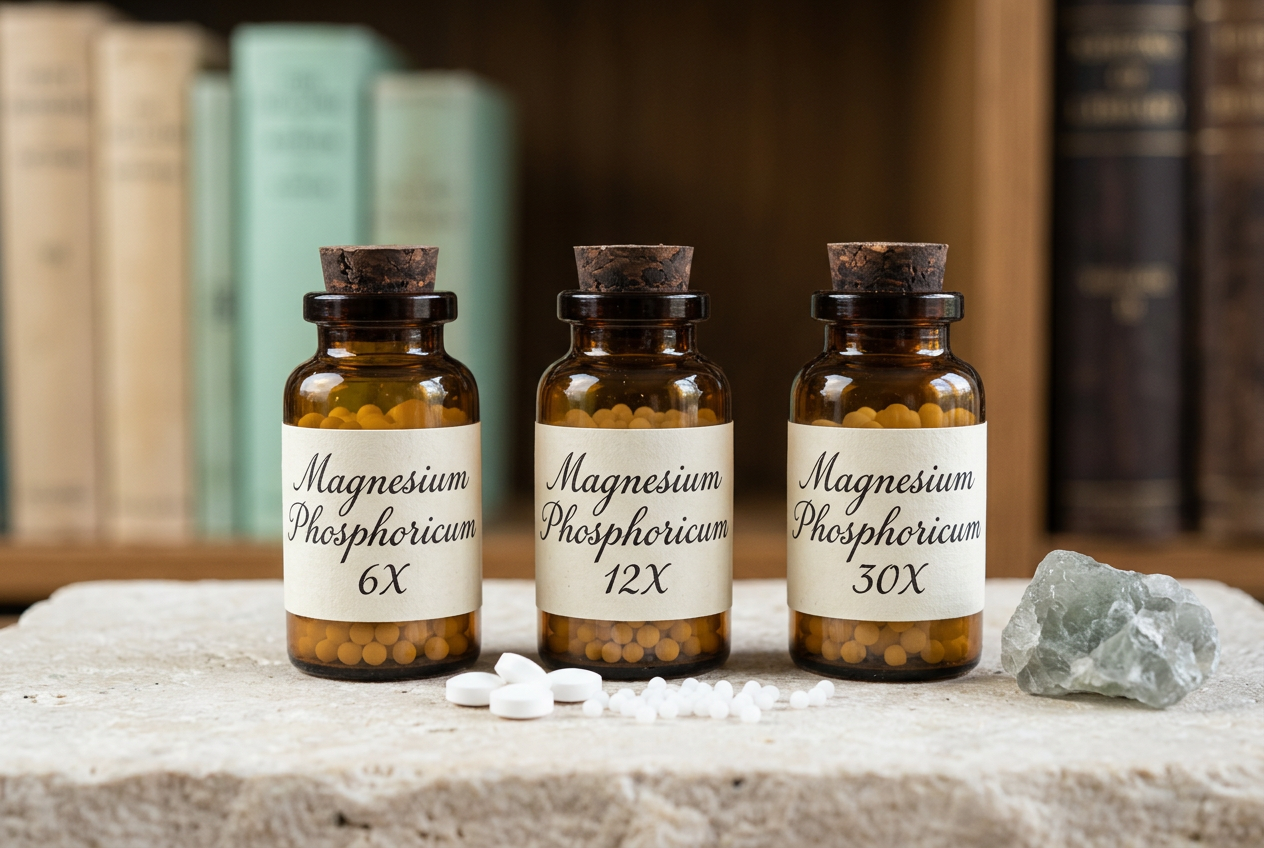
Available Preparations: 6X, 12X and 30X
Note on numbering: cell-salt numbering systems differ between manufacturers — Hyland’s, for example, numbers the salts in a different order from the classical Schüssler sequence. Always identify a preparation by its Latin name (e.g. Calcarea Sulphurica, Silicea), never by the number on the label alone.