WELLNESS & HEALTH · DR. HERMES
The Grippe Protocol: Schüssler’s Three-Salt Method for Influenza, Colds and the Respiratory Tract
A meticulous examination of the classical biochemic treatment of acute respiratory illness — the condition Dr. George W. Carey and the nineteenth-century school called la grippe — grounded directly in the original texts, with the precise indications of Ferrum Phosphoricum, Kalium Muriaticum (Kalium Chloratum) and Kalium Sulphuricum, and the warm-drink tradition that completes the protocol.
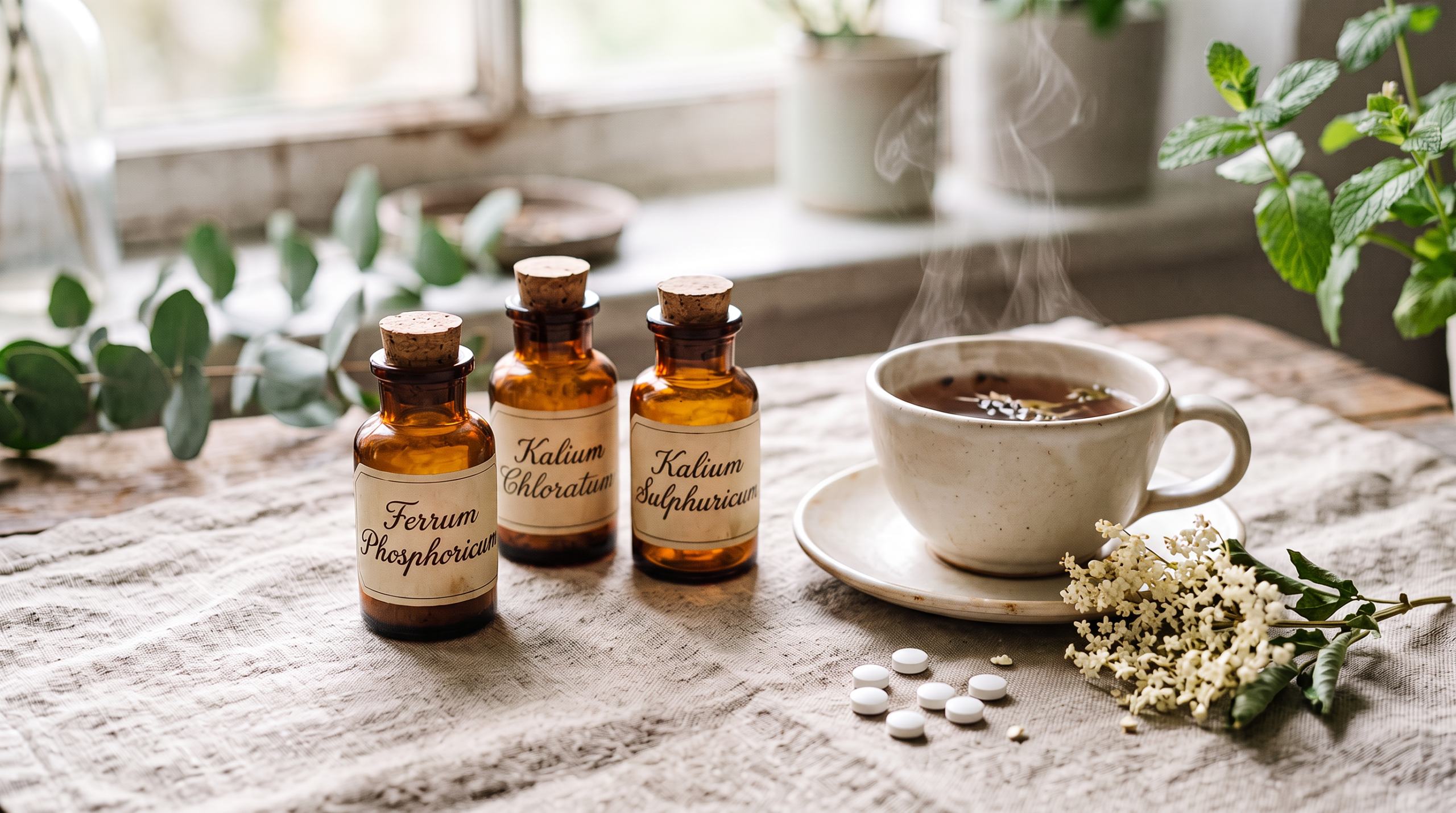
Every winter the same scene repeats itself in the consulting room: the sudden fever, the aching limbs, the raw throat, the congestion, the slow, stubborn recovery. The modern world calls it influenza, the common cold, a respiratory infection, or — in the viral seasons of recent memory — something with a newer name. The older world, the world of Dr. George W. Carey and the biochemic physicians, called it all one thing: la grippe.
And this is not a term of nostalgia. It is a term of precision. Carey, whose The Biochemic System of Medicine systematized the work of Dr. Wilhelm Schüssler for the English-speaking world, wrote of la grippe in terms that could have been written today: “The pathology of la grippe is the pathology of bad colds, pneumonia, bronchitis, pleurisy, catarrhs, etc.” Whether the agent is the influenza virus, the coronavirus, or one of the hundreds of rhinoviruses, the tissue response is the same — inflammation, exudation, congestion, exhaustion — and it is the tissue response that the biochemic method addresses.
What Happens During a Cold or Flu: The Stages of the Tissue Response
The biochemic physician does not treat the name of the disease; he treats the salt deficiency that the symptoms reveal. In acute respiratory illness the picture unfolds in recognizable stages, and each stage has its remedy:
- Stage One — the inflammatory onset. The first hours: heat, redness, flushing, the beginning of fever, throbbing congestion. The tissue is in the hyperaemic stage — blood rushing to the surface of the mucous membranes. This is the domain of Ferrum Phosphoricum.
- Stage Two — the exudative state. The congestion gives way to secretion: catarrh, mucus, sore throat, the white-coated tongue. The tissues are pouring out the products of the inflammatory process. The characteristic remedy here is Kalium Muriaticum (Kalium Chloratum): the salt selected for sore throat and the white-coated tongue of the exudative phase.
- Stage Three — the resolution. The exudation ripens: yellow or slimy discharges, the lingering congestion, the fever that rises in the afternoon and burns into the evening. This is the “last mile” of a cold, and its remedy is Kalium Sulphuricum.
Carey, writing the repertory, gave the stage doctrine with his usual economy: “FERR. PHOS. — In the first or hyperaemic stage, always before exudation has taken place. The principal symptoms are heat, redness, pain, etc. Given internally and applied locally, it will, in the majority of cases, prevent exudation.” And for the later stages: “KALI SULPH. — When the exudation has changed to a ripe yellow, or yellow, slimy discharges.”
The Three Salts of the Protocol
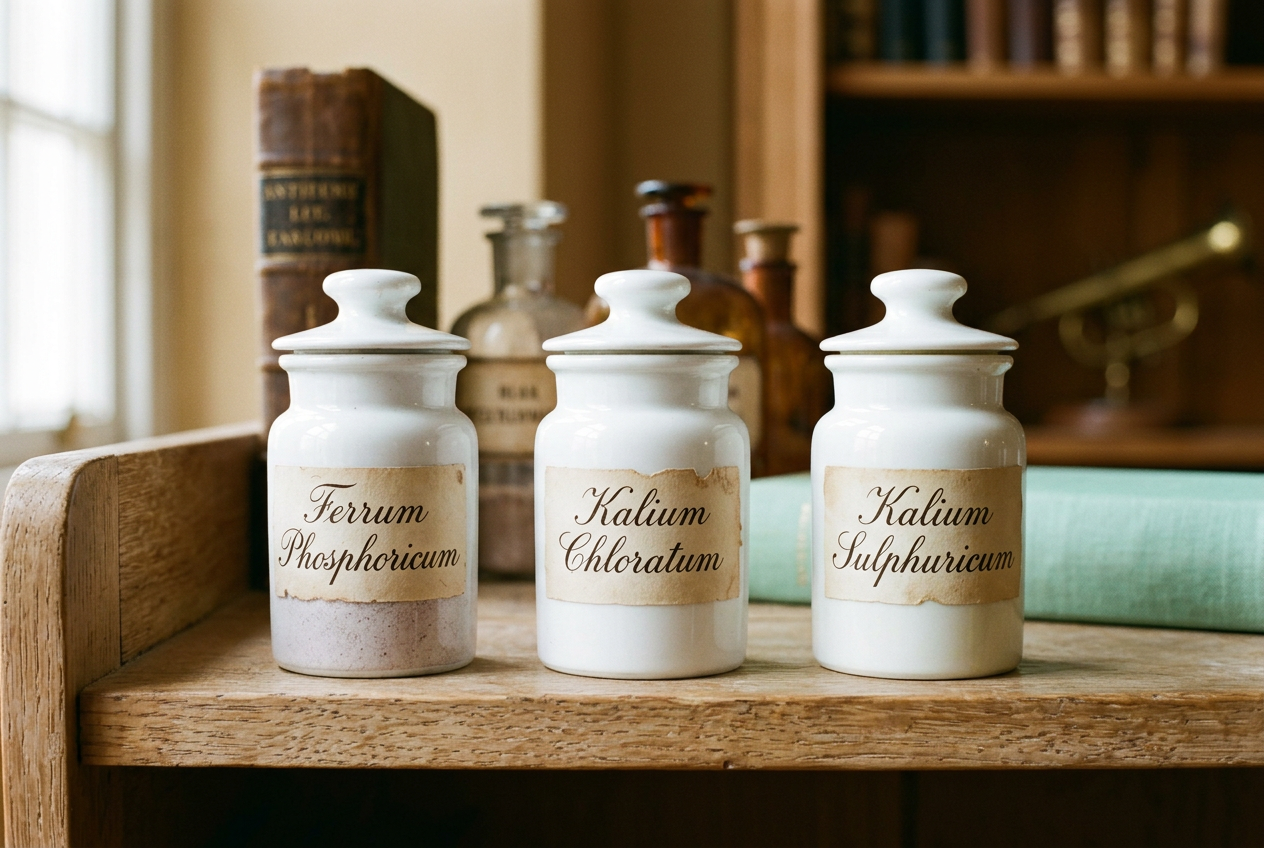
Ferrum Phosphoricum (No. 3) — the salt of the inflammatory onset
Schüssler’s third tissue salt is the iron salt, and in the biochemic doctrine iron deficiency is the beginning of the whole respiratory story. Carey’s explanation is physiological and exact. A deficiency of iron molecules means a lack of oxygen in the tissues; the circulation accelerates to compensate; and the increased molecular motion — by the law of the conservation of energy — is fever. The blood is drawn away from the skin to the vital organs; the pores close; waste matter that should escape through the skin is turned inward, and forms the exudation of colds, catarrh, pneumonia and pleurisy. His conclusion is blunt: “For all such conditions, whenever there is inflammation, under whatever name it may be known, Ferr. phos. is the chief remedy.”
In the grippe protocol, Ferrum Phosphoricum is the remedy of the first forty-eight hours: the early fever, the flushed face, the throbbing congestion, the quickened pulse. Carey’s instruction in his La Grippe section is precise: “The first or the initial stage of this condition, calls for the Ferr. phos.”
Kalium Muriaticum / Kalium Chloratum (No. 4) — the salt of the exudative stage
Kalium Muriaticum, also called Kalium Chloratum or Kali Mur, is potassium chloride. In the classical biochemic sequence it follows Ferrum Phosphoricum when the acute inflammation begins to produce exudation: catarrh, sore throat, a white or grey-coated tongue, swelling, and opaque white mucus.
Carey’s grippe instruction is exact: “If throat is sore, or white-coated tongue, Kali mur. should be given in alternation.” His repertory likewise places Kali Mur in the second stage of inflammation, “when exudation has taken place — indicated by recent swelling or discharge of opaque white mucus.” In this article it is therefore the second salt of the respiratory sequence, between Ferrum Phosphoricum at onset and Kalium Sulphuricum as yellow or slimy discharges develop.
Kalium Sulphuricum (No. 6) — the salt of the skin and the resolution
Schüssler’s sixth salt is the oxygen-carrier of the skin — the salt of the seven million pores. Carey’s physiology: “In health the microscope reveals the fact that little jets of steam are constantly escaping from the seven million pores of the skin… You may ask why a lack of proper balance of potassium sulphate molecules should cause a rise in temperature in the afternoon, and which does not subside till about midnight. The reply would be that at such times the molecules of this salt are carriers of oxygen.”
This is the salt of the late cold: the lingering congestion, the yellow or greenish slimy discharges, the fever that mounts in the afternoon and burns into the evening, the skin that stays dry and clogged. Its modality is characteristic and diagnostic: worse in the evening and in heated rooms, better in cool air. In the grippe protocol: “If afternoon aggravation, or very chilly, then give Kali sulph. with the Ferrum.”
The Stage-by-Stage Protocol, From the Text
Carey’s La Grippe section, in The Biochemic System of Medicine, gives the complete working protocol. It is worth reproducing faithfully:
“The first or the initial stage of this condition, calls for the Ferr. phos.; and if throat is sore, or white-coated tongue, Kali mur. should be given in alternation. If afternoon aggravation, or very chilly, then give Kali sulph. with the Ferrum. If exceedingly nervous, Kali phos. should be combined with the Ferrum. If sneezing, or watery discharge from eyes or nostrils, Natr. mur. is the remedy, in alternation with Ferrum, the chief remedy.”
The three salts of the title are the backbone: Ferrum Phosphoricum through the onset; Kalium Muriaticum / Kalium Chloratum for sore throat, white-coated tongue and opaque-white exudation; and Kalium Sulphuricum when the exudation ripens and the afternoon aggravation appears. Natrum Muriaticum remains the classical alternate for the streaming, sneezing cold; and in the epidemic experience of Carey’s colleagues, Natrum Sulphuricum was often the most-used remedy, “since the disease is caused by an excess of water in the cellular fluids.”

The Warm Drinks: Hot Water, Hot Herbal Tea, Hot Sponge Baths
The biochemic protocol of the grippe is not complete without its thermal dimension. Carey’s instruction is direct: “The patient should be encouraged to drink freely of hot water — it is death to la grippe microbes. Hot sponge-baths are excellent to open the pores.” The logic is the logic of the system: the fever has driven the blood inward and closed the pores; the skin, the great eliminating organ, must be opened again; the fluids must be replenished and the waste products carried out.
The tradition of warm herbal drinks — the tisanes of the European influenza home — builds directly on this instruction. Elderflower, the classic diaphoretic of the cold season, encourages the gentle perspiration that Carey asks of the hot sponge-bath. Lime blossom belongs to the traditional warm-drink practice for comfort during fever. Thyme, the antiseptic herb of the respiratory tract, supports the chest and the throat. Ginger warms the circulation from within. Honey and lemon soothe the raw mucosa and provide the sugars the exhausted patient can use at once. Taken hot, in quantity, through the course of the illness, these tisanes are the traditional complement of the three-salt protocol — the kitchen pharmacy that the biochemic literature always presupposed.

What the Record Shows: Schüssler and Carey on the Grippe
Carey’s own clinical experience of the grippe is recorded in his pages, and it is worth reading in his words:
“I have attended hundreds of cases called la grippe, and find the conditions the same as those heretofore known as severe bad colds, pneumonia, bronchitis, pleurisy, catarrhal fevers, etc. As to germs, bacilli, microbes, etc., they swarm throughout all nature and adhere to membranes in unhealthy conditions where a lack of some constituent of the blood has caused a decay and the throwing off of organic matter.”
His clinical cases, reported by collaborating physicians, include the Natrum Sulphuricum case in which a patient with profuse greenish mucus “in a few hours felt so much better that it was with difficulty he was kept in the house” and returned to work the following morning; and the Kali Muriaticum case of the sixteen-year-old girl taken with the grippe — profuse nasal discharge, rheumatic pains, high continuous fever, white-coated tongue, great depression — who, on Kali Muriaticum 3x every two hours, was “cured in three days.” These are the case records of the biochemic tradition: symptom-led, salt-matched, and — in the epidemic setting of their time — strikingly rapid.
The historical logic of the sequence is explicit in the text: Ferrum Phosphoricum at the initial inflammatory stage; Kalium Muriaticum when sore throat, white coating and opaque-white exudation appear; Kalium Sulphuricum for the later yellow or slimy discharge. The protocol is presented here as the staged approach described by Carey, not as a substitute for clinical assessment.
References
- Schüssler WH. An Abridged Therapy: Manual for the Biochemical Treatment of Disease. 25th ed. Philadelphia: Boericke & Tafel; 1898.
- Carey GW. The Biochemic System of Medicine: Comprising the Theory, Pathological Action, Therapeutical Application, Materia Medica and Repertory of Schüssler’s Twelve Tissue Remedies. St. Louis: F. August Luyties; 1894 (copyright 1893).
- Carey GW. The Chemistry of Human Life. 1919.
- Boericke W, Dewey WA. The Twelve Tissue Remedies of Schüssler. Philadelphia: Boericke & Tafel; 1910.
- Chapman JB, Perry EL. The Biochemic Handbook: What They Are, What They Will Do, How to Use Them. Exeter: New Era Laboratories; 1959.
- Clarke JH. A Dictionary of Practical Materia Medica. London: Homeopathic Publishing Company; 1900.
- Dewey WA. Practical Homeopathic Therapeutics. 2nd ed. Philadelphia: Boericke & Tafel; 1922.
- Homeopathic Pharmacopoeia of the United States (HPUS). Tissue salt monographs.
- United States Congress. Federal Food, Drug, and Cosmetic Act. Pub. L. No. 75-717, 52 Stat. 1040; 1938.
Resources
For the reader who wishes to study the primary texts and the remedies:
- The Biochemic System of Medicine — Dr. George W. Carey. The complete theory, materia medica and repertory, including the full La Grippe section quoted above. Buy on Amazon →
- An Abridged Therapy — Dr. W. H. Schüssler. The founding text of the biochemic system. Buy on Amazon →
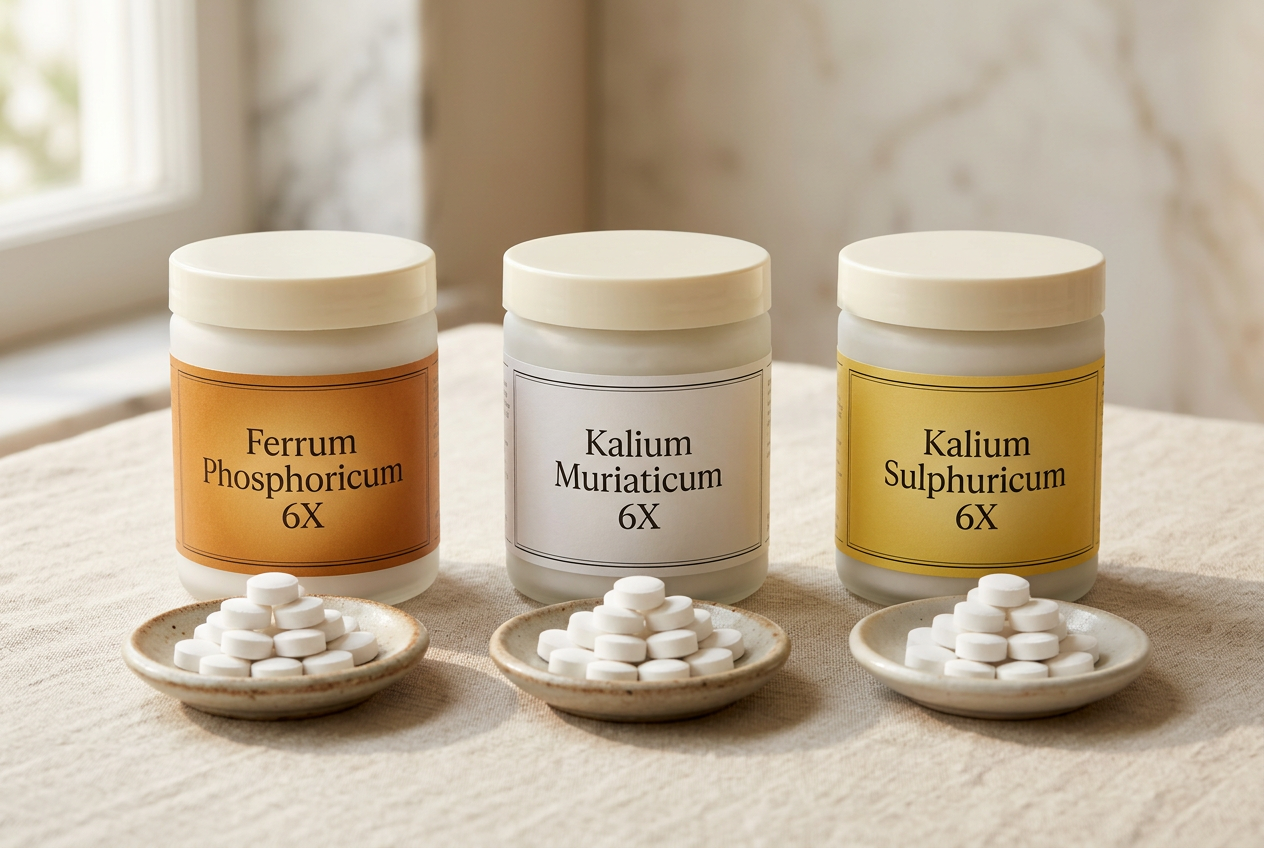
- Ferrum Phosphoricum 6X — Buy →
- Kalium Muriaticum 6X — Buy →
- Kalium Sulphuricum 6X — Buy →
Dr. Hermes Trismegistus
Doctorate in Biochemic Medicine (Schüssler System) · Chief Medical Scholar, ABUGALY Holistic-Medical Institute